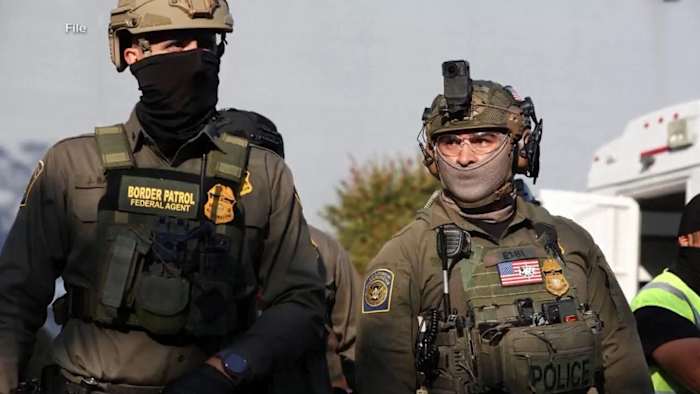
Immigration and Customs Enforcement (ICE) officers are set to begin wearing body-worn cameras nationwide this fall, but a key provision in the agency’s policy is raising concerns about public transparency — specifically, who decides what footage the public gets to see and when.
Congress allocated $20 million to the Department of Homeland Security for body cameras in April. ICE said it expects all officers to be wearing them by the end of September.
According to the agency’s policy, which was released in February 2025, officers are required to activate their cameras during enforcement activities, including arrests, execution of warrants and removal operations. The policy also states officers should activate cameras as soon as an enforcement activity begins.
The cameras are designed to capture at least 30 seconds of video before an officer presses record, a feature commonly referred to as a pre-event buffer.
ICE said the purpose of the new requirement is to improve transparency, accountability and safety during enforcement operations.
Public concern over the lack of body cameras has intensified following a series of deadly shootings this year, including two in Minneapolis, one in Houston and one in Maine. ICE officers were not wearing body cameras during those encounters.
If a body camera captures a serious bodily injury or death in custody, ICE said the footage will go through an expedited review process handled by a designated review group, which include the agency’s deputy director.
When it comes to releasing that footage to the public, the agency’s director, along with a designee, makes the final call on whether it is in the agency’s “best interest” to release it.
KSAT asked ICE to define what the agency means by “best interest” when deciding whether to release footage. ICE acknowledged our questions and said it would provide updated details when available.
To better understand concerns about the policy’s standard, KSAT also reached out to the Freedom of Information Foundation of Texas, a nonprofit organization focused on government transparency and public access to information. They sent the following statement in response:
“The standard of ‘in the agency’s best interests’ has never been an allowed argument to withhold information and creates in the agency an entity whose interests and priorities are independent from and above those of the constituent public. On its face, this standard is designed to foreclose transparency. Further, it is the opposite of the conservative ideal of limited government.
From an institutional perspective, deferring to an agency’s ‘best interests’ will be to favor it to aggregate power and defeat accountability. This is opposed to the public’s ‘best interest’ which is to ultimately that the people control their own government and ensure it is operating in, well, the public’s best interest. Under this new ICE policy, the agency’s ‘best interests’ (such as they are) overrides all other concerns and will allow complete discretion regarding what gets released. ICE is telling the public that “access to this information is on a need to know basis, and you don’t need to know.’ The public will never see body camera footage under this policy unless it is leaked.”
Freedom of Information Foundation of Texas
Read also: