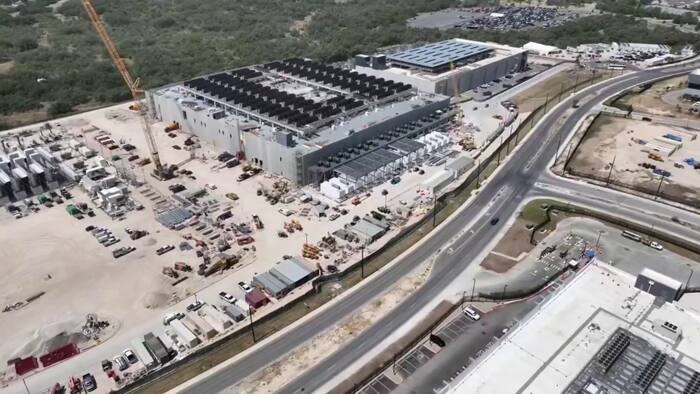
San Antonio leaders are looking at whether data centers should be required to use recycled water instead of drinking water as concerns grow about the potential impact of future artificial intelligence facilities.
San Antonio’s District 6 Councilman Ric Galvan filed a council consideration request (CCR) almost a year ago to have city staff look into the impact data centers have on city resources and look at the possibility of requiring data centers to use recycled water.
Water is used to cool down the industrial servers that data centers use for extended periods of time.
Water is also used to produce power for the facilities.
KSAT attempted to speak to Galvan about the recycled water proposal, but his office sent a statement.
In it, Galvan said he wants to keep data centers from using any drinking water, and in order for a mandate on recycled water usage by data centers can move forward, San Antonio Water System (SAWS) must adopt a policy first, specifically outlining that that is what data centers must do.
Donovan Burton, the senior vice president of water resources and governmental relations for SAWS, said when talking about data centers in the city, there must be a distinction made between existing data centers and future AI data centers and their water consumption.
He said 23 of the existing data centers in the city account for a very small amount of the water pulled from the city’s water supply.
“The existing data centers are very small (and have a) very, very small footprint. In fact, they’re using about .1% of our potable water supply,” Burton said.
He said it is the future AI data centers that could potentially use a lot more water, and added SAWS’ Recycled Water Network could help data centers comply if the recycled water use became an official requirement.
“Our Recycle Water Network has been in place for over 20 years,” he said.
He explained that it is 130 miles of purple pipeline that specifically carries recycled water that is used and paid for by contracted, non-residential customers.
“The recycle water programs, after (water) has been used, we treat it and put it into a purple pipe network that goes around … a good portion of the entire city,” Burton said. “That network then takes it from three different plants, and we can move water back and forth.”
SAWS headquarters, CPS Energy, Toyota, the San Antonio Zoo and the River Walk are among the multiple big entities and attractions that are connected in part or entirely to SAWS’ Recycled Water Network, and you can tell by the designated purple pipes present on or near the respective properties.
Burton said if a recycled water use restriction is implemented, data center owners would have to choose to obtain a permit from SAWS and enter into a contract for a specific amount of water to connect to the purple pipeline.
But he shared there is another option data centers have that can be a conservative measure.
“Some of them are going to a closed loop (water) system, which will end up using a lot less water,” Burton said.
An internet search on what a closed loop water system is yielded a general definition, describing how data center use the same water or a cooling liquid through sealed pipes to absorb heat and as it moves along the pipe path it removes heat from servers over and over again without pulling in or using fresh water.
Until further notice, Burton said SAWS will continue its forward strategy.
“It’s a matter of making sure that that works for all future customers, not just a very few one or two or five data centers or anything else,” he said.
In the statement sent to KSAT, Galvan said he asked SAWS leadership to come up with a possible plan to move forward with the water usage restriction for new data centers.
The statement went on to say he is interested in hearing from SAWS this week as to whether or not the board has made any movement on the proposal over the summer.