Experts credit smooth midterms to election workers, Democratic rout
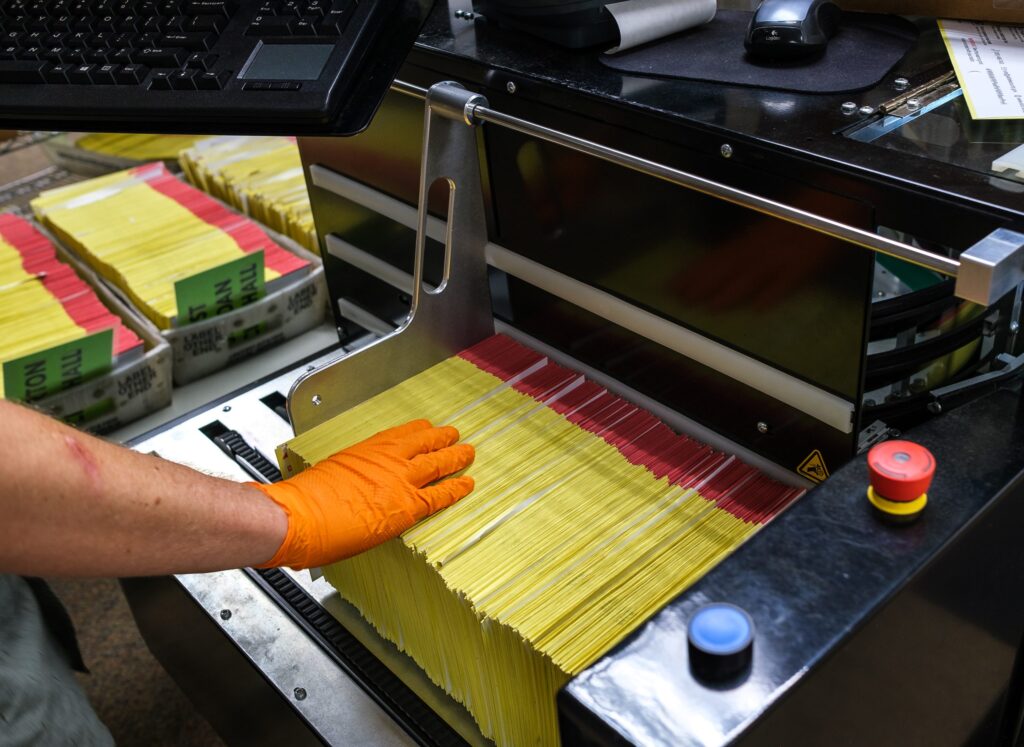
After President Donald Trump’s aggressive push for control over elections, this month’s midterms went smoothly because of the resilience of state and local officials and Democrats’ sweeping victories, several election experts said Monday. Nearly two weeks after Election Day, a panel of researchers and former local government officials expressed relief that the election system held. But panelists at the discussion, hosted virtually by the Safeguarding Democracy Project at the University of California, Los Angeles, also warned against complacency about future contests. “It didn’t happen magically,” said Bill Gates, executive director of Arizona State University’s Mechanics of Democracy Laboratory, which supports efforts to combat election misinformation. Election officials and voting rights advocates had braced for a chaotic aftermath to the election, including potential federal interference in voting. Election workers across the country gameplanned how they would react if federal agents showed up at the polls or tried to disrupt vote counting. But on Election Day, no major incidents occurred and voting proceeded without federal interference. Gates and others credited election workers, saying their preparation — including for the possibility of disruption — ultimately helped ensure smooth voting. “They were really concerned about federal intervention. It was their top concern at every single one of our events in the last year,” said Tammy Patrick, chief programs officer at Election Center, an operation of the National Association of Election Officials. Trump toyed with meddling The U.S. Constitution assigns states the responsibility of administering federal elections. Congress may override state election regulations, but the president has no unilateral authority over how elections are run. Despite that, Trump made repeated attempts to assert such authority, including by signing executive orders attempting to impose a federal proof of citizenship requirement to vote and directing the U.S. Postal Service to impose restrictions on ballots sent through the mail. Major portions of both orders have been blocked by federal courts. The U.S. Supreme Court halted the mail-ballot restrictions for the midterms, but their legality for the 2028 election remains unsettled. Charles Stewart III, a professor of political science at the Massachusetts Institute of Technology, said the federal government was often “feckless” in its efforts to bend the election system. The decentralized nature of the electoral system — where states run their elections — also helped protect it, he said, against a “federal government that lacked the capacity to do a lot of things folks were worried about.” The Trump administration launched an array of legal challenges in the leadup to the election. For months, the U.S. Department of Justice pursued dozens of lawsuits seeking sensitive voter data from states, though none have been successful. Weeks before Election Day, the DOJ sued California to force the state to set aside ballots from suspected noncitizen voters. It also preemptively sued Alaska over the certification of its U.S. Senate race, and demanded ballots be set aside in Washington state. Federal judges blocked the legal challenges in California and Alaska, and a judge prohibited the DOJ from forcing election officials to segregate ballots in Washington state. Guy-Uriel Charles, a professor of law at Harvard Law School, said that in many ways, the pre-election litigation was a good development. “Instead of going and putting troops or agents at the polls … the Trump administration litigated their disputes,” Charles said. Blue wave swept out challenges As the results were counted, the broad nature of the Democrats’ wins tamped down on the possibility of a chaotic post-election period, the panelists said. At least at the national level, very few high-profile contests were extremely close, leaving less room for legal fights or claims of fraud. The…
Originally published by News From The States.
Read the original article