Democratic wins create abortion rights opportunities in states with strict laws
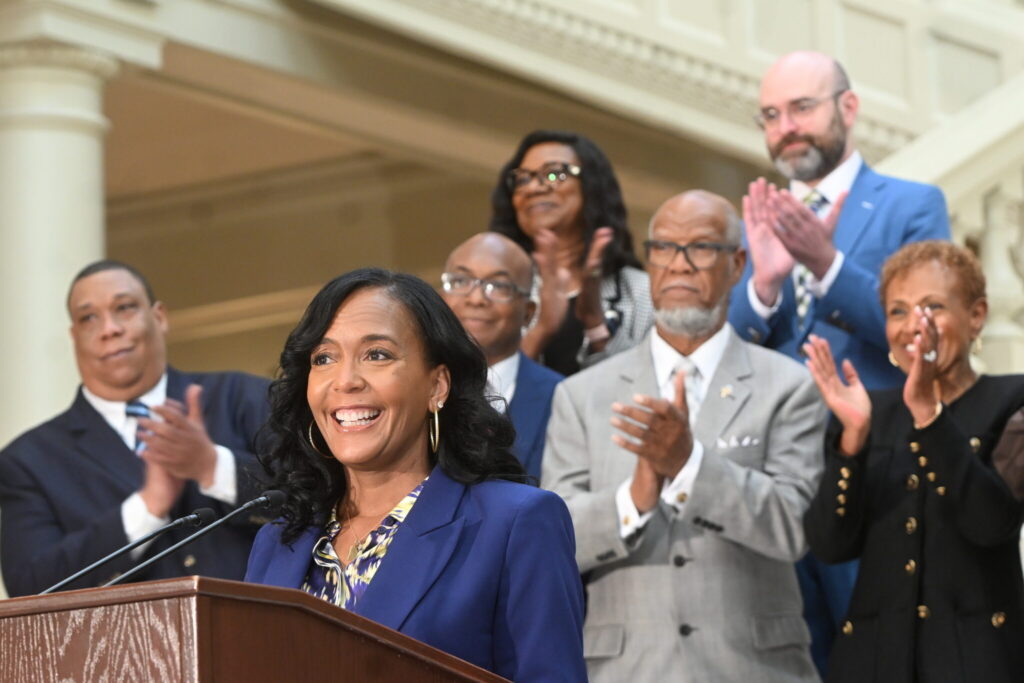
Georgia Democratic Gov.-elect Keisha Lance Bottoms spoke last week at the state Capitol about her transition into office. In Georgia, Iowa and Texas, sweeping Democratic election wins could advance abortion access. (Photo by Ross Williams/Georgia Recorder)
Sweeping Democratic election wins could advance abortion access in states with tight restrictions, especially in Georgia, Iowa and Texas, where Democrats seized the governor’s office for the first time in decades.
All three states will have Democratic attorneys general, and in Georgia and Texas, Democrats will control the state House while Republicans retain the state Senate. Texas has a strict abortion ban, while Iowa and Georgia only allow it up to about six weeks of pregnancy.
Meanwhile, in Arizona, Michigan, Minnesota, Pennsylvania and Wisconsin, Democrats have won new “trifectas” — control of the governor’s office and both legislative chambers — creating new opportunities to expand abortion rights. Both Pennsylvania Democratic Gov. Josh Shapiro and Wisconsin Democratic Gov.-elect David Crowley have already pledged to codify abortion rights through state law or constitutional amendment.
Abortion rights supporters also won victories in three of the four states — Missouri, Nevada and Virginia — where abortion-related measures were on the ballot. The lone exception was Idaho, where voters preserved their state’s strict abortion ban.
State consequences are already on display in Texas, where Democratic Attorney General-elect Nathan Johnson has promised to stop suing telehealth abortion providers in other states. Johnson’s proclamation is a stark reversal of the policy of his Republican predecessor, Ken Paxton, who failed in his bid to become a U.S. senator.
“My hope in humanity has been restored a little bit, and I don’t think I even realized how much that was wearing on me behind the scenes for the last two years,” said Kaitlyn Kash, who left Texas in 2021 to obtain an abortion in Kansas after fatal fetal complications threatened her pregnancy and potentially her own health.
Kash was among several plaintiffs who joined the 2023 Zurawski v. Texas lawsuit seeking to clarify the state’s medical emergency exceptions to its abortion ban. In 2024, the Texas Supreme Court ruled 9-0 in favor of the state.
But future abortion cases could see different outcomes: Last week, Democrats won all four Texas Supreme Court seats that were up for election. That leaves the GOP with a narrow 5-4 advantage on the state Supreme Court.
“To not have a vindictive attorney general anymore is going to save lives,” Kash said, referring to actions Paxton has taken, including bringing legal actions against abortion providers inside and outside the state and petitioning the state Supreme Court to halt a court ruling allowing the termination of a nonviable pregnancy.
Less impact in Washington
Despite huge Democratic gains in Congress, the change at the federal level is likely to be less significant, at least in the short term. President Donald Trump won’t leave office until January 2029, and Democrats did not win a filibuster-proof 60 seats in the Senate, let alone the two-thirds majority in the House and Senate they would need to override a presidential veto.
“As long as Trump holds executive and veto powers, we have more work than celebrating to do,” said Brittany Fonteno, president and CEO of the National Abortion Federation in a written statement. “The next two years will be a critical time to prepare for the kind of governing power that will deliver real and lasting reproductive freedom.”
Nevertheless, national abortion rights leaders have signaled high expectations for candidates they helped send to Congress, and they want Democrats to fight to preserve telehealth abortion. If Dr. Heidi Overton, Trump’s controversial pick to oversee the U.S. Food and Drug Administration, is not confirmed during the upcoming lame duck session, abortion-rights advocates will look to the new Democratic-dominated Senate to block her nomination.
“The Senate just became the backstop,” said Gowri Buddiga, campaign director of Free & Just, an abortion rights advocacy group, in a written statement. “An FDA nominee who’s spent years calling medication abortion dangerous now has to get past a chamber that’s heard from the women these bans have hurt.”
Unlike the 2022 midterms, which were held just months after the U.S. Supreme Court struck down the federal right to an abortion, there is debate over just how important abortion was in this election. According to an exit poll conducted for The Associated Press, 39% of voters cited the economy as their top issue, 33% said it was the state of American democracy and 14% pointed to immigration. No other issue broke single digits and abortion was not among the top six.
But abortion law expert Mary Ziegler said that while abortion appears to have been less of a top-of-mind issue this year, that’s not because voters care less about it.
“It’s that there was nothing happening with abortion right now, and that isn’t just a fun coincidence,” said Ziegler, a professor at UC Davis School of Law. “That’s because the Trump administration has been trying really hard to kick down the road any litigation or federal restrictions that would have made it front of mind for voters again.”
Ziegler said there are certain avenues that congressional Democrats could explore to expand access to abortion federally. Even if those efforts fail, she said, they might benefit Democrats politically leading up to the next presidential election in 2028.
“While Republicans have successfully drawn attention away from abortion, they haven’t really actually made abortion a good issue for Republicans,” she said. “So I don’t see what the harm would be in passing a bill that would be popular and having Trump veto it and have J.D. Vance and Marco Rubio have to defend it, because it’s been very good for Republicans not to have to talk about this issue at all.”
For their part, anti-abortion organizations have blamed Republicans and Trump for not campaigning on the issue and ignoring an important voting base, pointing to the highly funded and victorious anti-abortion win in Idaho as evidence.
“Let’s be clear: the GOP didn’t run on abortion in 2026. It ran an ostrich campaign: a big elephant with its head buried in the sand,” wrote Students for Life of America President Kristan Hawkins in a subscriber email the day after Election Day.
Hawkins also noted that several prominent Republican congressional candidates who said they supported abortion rights, including U.S. Sen. Susan Collins of Maine, U.S. Rep. Mike Lawler of New York and U.S. Rep. Brian Fitzpatrick of Pennsylvania, lost their seats.
Storytelling strategy
Abortion rights advocates argue that many voters were moved by the personal stories they heard from candidates and their surrogates.
On the campaign trail in Texas, Democratic Gov.-elect Gina Hinojosa talked about her own nonviable pregnancy and argued that women and families should be able to make their own reproductive health decisions. She has publicly supported ending Texas’ abortion ban and restoring abortion access, a steep challenge given that Republicans still control the state Senate.
In Georgia, Turiya Tomlin-Randall campaigned for Democratic Gov.-elect Keisha Lance Bottoms and Democratic U.S. Sen. Jon Ossoff, who was reelected.
Tomlin-Randall lives in Kansas City, Missouri, but her sister Candi Miller was living in Georgia in 2022 when she became pregnant. Miller and her husband had three kids and Miller had lupus, diabetes and hypertension, which made pregnancy dangerous. But she was terrified of getting into legal trouble after Georgia passed its new law. She ordered abortion pills online, but when she started experiencing a life-threatening infection, she was too scared to go to the hospital and died at home in November 2022.
Tomlin-Randall said she only learned two years later that her sister’s death was connected to the state’s abortion law, because of ProPublica’s reporting on deaths related to abortion bans in Georgia and Texas.
“This journey has taught me so much more about the effects of the ban,” said Tomlin-Randall, who is now raising two of the three children Miller left behind. “I’ve learned that most women who have abortions aren’t having abortions because they just don’t want to have a child. A lot of the women that I’ve encountered had to have abortions for their own safety.”
Tomlin-Randall said she’s hopeful Bottoms will be a vocal advocate for abortion rights. Georgia Democratic Attorney General-elect Tanya Miller also has opposed the state’s six-week abortion ban and promised to defend access to legal reproductive health care. Miller defeated a prominent anti-abortion lawmaker in her race.
Lauren Peterson, co-founder and CEO of Abortion in America, which organizes storytellers and advocates for abortion rights, called abortion the “unsung hero” of this election. She said abortion storytelling is an effective political strategy.
“Our work is not over,” Peterson said. “Even in states where we won, we are going to have to now do the important work of holding people accountable to the promises they made.”
Stateline reporter Sofia Resnick can be reached at sresnick@stateline.org.
SUPPORT: YOU MAKE OUR WORK POSSIBLE
Originally published by
Stateline.
Read the original article