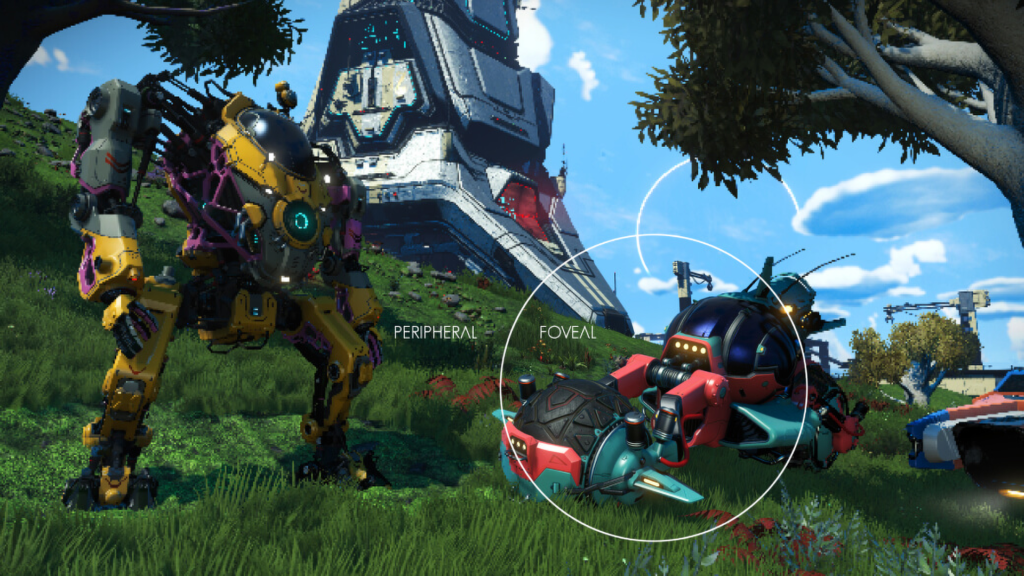
Today’s Cosmos update for No Man’s Sky adds support for eye-tracked dynamic foveated rendering on SteamVR, providing a performance boost for the game ahead of the release of Valve’s eye-tracking supported Steam Frame headset.
Hidden deep in the patch notes for the Cosmos update, about a third of the way down the ‘Rendering’ section, were these two notes:
- Added support for foveated rendering on PCVR.
- Utilizing eye-tracking technology, foveated rendering concentrates rendering resources at the center of your vision, sharpening and beautifying the details you focus on.
 Henry Stockdale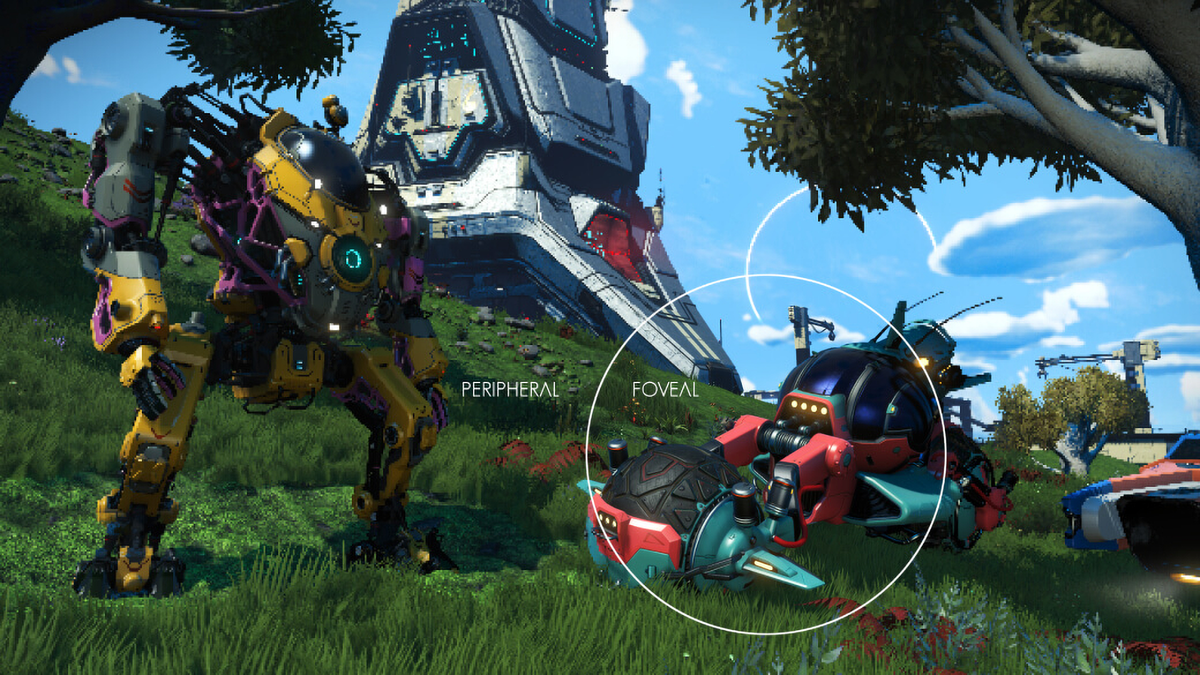
Hello Games previously added the same feature to the PlayStation VR2 version of the game in August 2023. Prior to that update, players complained of blurry visuals on Sony’s then-recently-launched headset. Post update, players who have played No Man’s Sky on both SteamVR and PS VR2 said the PlayStation version provided the best visual experience.
We cannot help but note the curious timing of this update. PC VR has had multiple headsets with eye tracking as a feature for years, including the Meta Quest Pro, Pimax Crystal Super and Vive Focus Vision. That said, looking at the most recent Steam hardware survey for August 2026, the eye-tracking supported headset with the highest percentage of users on SteamVR is the PlayStation VR2 at a mere 2.24% followed by the Quest Pro at 1.51%. SteamVR averages 1.8M-3M users in a given month, so the high end of those two combined is just over 110,000 users per month and there is no chance all of them are playing No Man’s Sky.
However, with the imminent launch of Valve’s highly-anticipated Steam Frame, there will presumably be a wave of users with an eye-tracking supported headset on the platform.
Speaking from experience, No Man’s Sky is a tough game to get running well in VR on PC. The procedural generation baked into the game taxes CPUs and adding the GPU overhead required for high resolution rendering in VR creates a tall task for anything below a top tier PC. I personally had to lower the resolution scale to around fifty percent and drop the in-game graphics to just above the lowest settings to get an acceptable framerate, sacrificing visual fidelity in the process. This was on a Quest 3 using an RTX 3070 and a Ryzen 5 5600X. I upgraded my PC earlier this year, moving to a Ryzen 7 9850X3D CPU and an RTX 5070 Ti and I still have to reduce the graphics from the max settings I normally play the game at when I play flatscreen. While the experience is great in VR, I am still nerfing the graphics to make it playable.
Going off my experience, the chances of a performant standalone Steam Frame version of No Man’s Sky running on a mobile chipset are slim to none. So it makes business sense to capitalize on a high-profile, hotly anticipated headset with eye-tracking with this update, enticing users to add No Man’s Sky to the list of PC VR games to test when they get their Steam Frames. We do not know if the performance boost with eye-tracked dynamic foveated rendering will bring the same night-and-day difference PlayStation VR2 users experienced, but it can only help.
No Man’s Sky Cosmos is available now on all supported platforms, including SteamVR and PlayStation VR2.