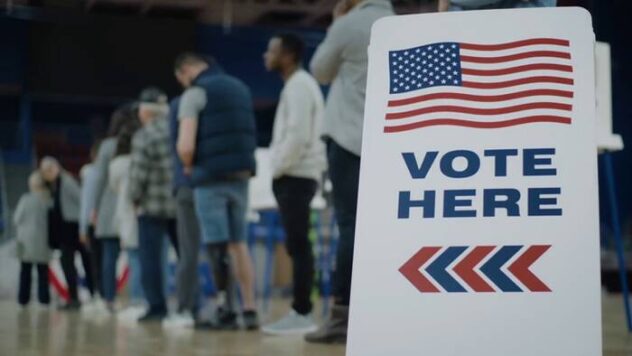
Latino voters make up a significant share of Texas’ electorate, and their support could help shape several races in the 2026 midterm elections.
But neither political party can take that support for granted.
Several South Texas counties that voted Democratic in 2020 shifted to Republican in the 2024 presidential election. Now, with Election Day approaching on Nov. 3, the question is whether those counties will stay red or move to back the blue.
Texas has nearly 6.3 million eligible Latino voters, making up about 31.7% of the state’s eligible electorate, according to the UCLA Latino Policy and Politics Institute.
David Crockett, a political science professor at Trinity University, said that growing share makes Latino voters an important group for candidates to reach.
“They are a growing percentage of the population and a growing percentage of the electorate,” Crockett said.
He said Latino voters can support candidates from either party.
“It’s a swing vote that can be earned by either side,” Crockett added.
Counties including Webb, Starr, Hidalgo and Cameron voted Democratic in the 2020 presidential election before shifting to Republican in 2024.
The Republican share of the two-party presidential vote rose from 38.2% to 51.1% in Webb County and from 47.5% to 58% in Starr County. Hidalgo and Cameron counties also shifted to Republican majorities.
Those numbers reflect all voters in those counties, not Latino voters alone. Still, they show how much the region’s political landscape changed in one election. Whether those gains hold in 2026 remains an open question.
The economy is a major concern for Latino voters. A recent survey found that 86% of Latino registered voters consider it very important to their congressional vote. Concerns about gas prices, housing and the cost of everyday goods were also widespread.
Crockett said those pressures affect Latino families just as they do other voters.
“If gas prices are in excess of $4 a gallon, they’re going to feel that as much as you or I feel that,” he said.
Immigration enforcement is another issue. A recent poll found that 56% of Texas Latino voters believe the current administration’s immigration enforcement efforts have been excessive.
The same poll found Democrats leading among Latino voters in several major Texas races. Democrat Gina Hinojosa led Republican Gov. Greg Abbott, 52% to 43%, while in the U.S. Senate race Democrat James Talarico led Republican Ken Paxton, 55% to 37%.
A separate University of Houston Hobby School survey found similar statewide results but also highlighted differences between rural and urban Latino voters. Rural Latino voters favored Abbott over Hinojosa, 60% to 36%, and Paxton over Talarico, 56% to 24%. Urban Latino voters favored Hinojosa over Abbott, 58% to 41%.
The findings show that Latino voters across Texas do not share one set of political priorities or voting preferences.
Crockett said voters may reassess their choices after seeing how elected officials govern.
“When they’ve had to govern and make unpopular decisions and things are a little rockier, they lose some of that vote that they got in the presidential election,” he mentioned.
For some other Latino voters, the focus is not just on party affiliation, but on whether candidates stay involved in their communities and deliver on their promises.
Zoe Zamora, who first voted in the 2024 election, said that community involvement matters to her.
“I like whenever they’re really involved in our community and not just saying one thing and then doing something completely opposite or just not doing anything at all,” Zamora said.
She said she hopes to see elected officials continue that kind of involvement after the election.
“I hope we see that more often after this election. I have a lot of confidence in the people that I voted for,” she added.
Turnout will also be important. Midterm elections typically draw fewer voters than presidential elections, and the makeup of the electorate can change from one election to the next.
Pew Research Center found that Latino voters are more engaged in this year’s midterm election than they were at a similar point before the 2022 election. The survey also found that Latino voters who support Democratic congressional candidates report higher levels of motivation to vote than those supporting Republican candidates.
Crockett said Bexar County and South Texas will be important areas to watch, particularly in congressional districts affected by redistricting.
For Democrats, the challenge is to build on their support among Latino voters and compete in communities where Republicans made gains. For Republicans, it is to maintain the support they gained in 2024 while addressing concerns about the economy, immigration enforcement and other issues.
As Election Day approaches, the results in South Texas could offer another indication of whether the region’s shift toward Republicans will continue, or whether voters will move in a different direction.
More Vote 2026 coverage on KSAT: