Spurs vs Knicks: Game 1 analysis and adjustments moving forward
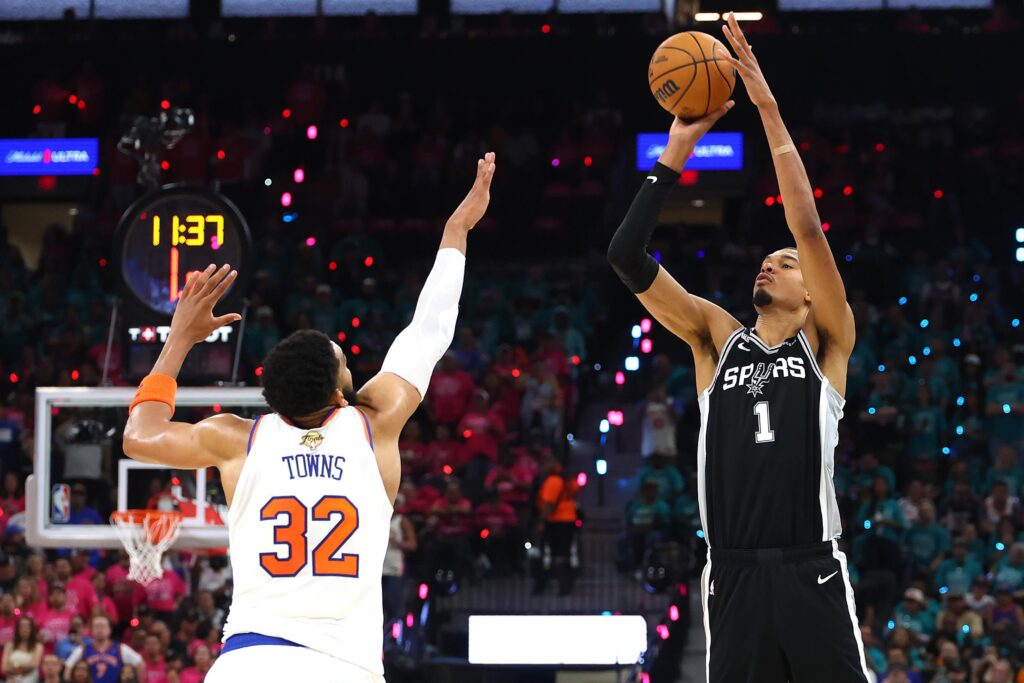
Since February 1st, Wemby has only finished a game with a negative plus/minus three times. Once was in game five of the West Finals against OKC, and the other two times were both against the Knicks, including Wednesday night.
It’s undeniable that New York has a matchup advantage against the Spurs, and it all starts with KAT. Big Purr was undoubtedly the best player in game 1, but San Antonio also made some head-scratching mistakes when guarding him, which should be easily correctable moving forward.
Give the KAT some space!
KAT’s one of the best big man shooters ever, but he still shouldn’t be guarded like Steph Curry.
There were a handful of possessions in game 1 where Wemby or Kornet were glued to his hip, which made it easy for him to drive or pass to cutters.
The Spurs should not sag off KAT, but rather stay close enough to contest shots without giving him the ability to easily blow by on drives. This would also give San Antonio’s bigs an easier time navigating screens, as they would have more room to operate.
Lastly, it’s crucial that the Spurs keep their bigs on KAT, for now. Sure, they can always have them sag off of Hart, but KAT proved in game 1 that his size is too much for any other player to handle, which resulted in a number of offensive rebounds and lobs for New York.
Even in this play, Wemby overplayed the pass from Hart when he should’ve been in a deep drop. This is a very easy mistake to fix, and once Wemby understands his assignments better, the Spurs should bounce back nicely moving forward.
The 3-guard lineup and other rotation changes
Even though Harper played too few minutes and Fox was bad, the answer is not to replace the veteran with the rook, but rather to play them together. This accomplishes several things at once: it decreases the erratic minutes from Bryant and Barnesy, limits Brunson’s opportunities to hunt Champagnie, and gives the Spurs more chances to run actions with another ballhandler on the floor. Most importantly, it allows the Spurs to play arguably their second-best player more, who should be fresh given that he’s a 20-year-old who has averaged under 26 minutes during the postseason.
Even in game 1, Harper played just 27:31, while Barnes and Bryant combined for 16:34 of straight cardio. Harper can absorb more than half of those minutes alone, and at this point, the Spurs should only be playing him, Kornet, and Big Body consistent bench minutes. Defensively, the rookie arguably had the best game guarding Brunson, and starting a lineup that includes all three guards would give Captain Knick fewer chances to hunt Champagnie, who was his favorite target in game 1. Matching Harper with Brunson also frees Castle up to guard a bigger player like Anunoby, who can play bully ball against the Spurs’ wings.
To be clear, Harper should take minutes away from Bryant and Barnes, not Champagnie. The latter should still play his usual amount, but more with bench units. Mitch Johnson also needs to match Kornet and the bench with the Knicks’ secondary unit. Brunson got going in game 1 by attacking Bryant and Kornet in the non-Wemby minutes, and the Spurs need to prevent that from happening again by matching the stars’ rotations.
These are all trickle-down effects of playing all three guards together, and we haven’t even gotten to the most exciting part yet: the offense.
Hunt New York’s small guards
Landry Shamet played over 33 minutes in game 1, which was more than both Mikal Bridges and Josh Hart. Even Alvarado and Clarkson got some run, combining for 16:36 in the opening match.
The Spurs did a decent job of hunting New York’s small guards when they had favorable matchups, like what Castle did on this possession.
However, they didn’t manage to make the Knicks pay enough, resulting in Shamet going 3-6 from deep when the rest of New York shot 8-33. If the Spurs do play more three-guard lineups, they need to hunt the Knicks’ backcourt ruthlessly, forcing Mike Brown to try other lineups.
Specifically, San Antonio needs to put both Knick guards in the action whenever possible. One of the main reasons why New York’s point of attack defense has held up surprisingly well during the playoffs is because they’ve perfected protecting Brunson and other small guards through hedging and recovering. However, if you put two poor defenders in the same action, they won’t have anywhere to hide, and that’s what happened in the play below, where New York successfully recovers Brunson from being hunted, but Shamet is forced to be the one scrambling back onto Fox.
That play worked with Champagnie as the screener. Now, can you imagine how much more lethal it would be if all three guards took turns hunting, with one of them screening? That would open up so many more options offensively and there would be nowhere for New York’s guards to hide. In turn, the Knicks would be forced to play Shamet and co. fewer minutes, thus decreasing their spacing on the other end, too.
Replace the Wemby isos with screening actions, please!!
Speaking of screens, the Spurs need to replace Wemby isos with them as well. KAT is big and mobile enough to prevent the Alien from getting to the rim, and the Knicks can replace him with an equally tough matchup in Anunoby too.
Wemby can continue shooting when he’s open, but on halfcourt plays, the Spurs operate better when he’s doing big man things. This means using his size to set hard screens (which he failed to do in game 1) and rolling when he can. Such opportunities are hard to come by, but the one play that I’ve yet to see fail is a double screening action that results in Wemby going downhill, which either opens up a lob or a kickout to a corner shooter, who should be wide open since his man will be too preoccupied with Wemby.
However, if Wemby is forced to be on the perimeter, the Spurs should use him more as a playmaking hub rather than a scorer. Similar to KAT, Wemby’s shooting pulls opposing bigs out, and this leaves the rim open for San Antonio’s slashing guards to attack.
New York’s length on the wings makes drives much harder than OKC’s smaller guards did, but Point Wemby is still a look that the Spurs should consider using. Still, even that shouldn’t be a priority, as San Antonio can run much more creative things using their guards that yield better looks.
Cutting down on Wemby’s iso saves the Spurs from running an inefficient play, while also preserving the Alien’s energy. I have no doubt that he’ll end up with a huge positive plus/minus by the end of the series, and the Spurs will need to play him as many minutes as possible to lift the Larry O’Brien trophy.