The San Antonio City Council batted down Mayor Gina Ortiz Jones’ attempt to get the city’s funding for a downtown Spurs arena onto the November ballot in a 5-6 vote Monday.
Unlike the county’s $311 million share of funding, which roughly 52% of voters approved last November, the city’s $489 million proposed financing does not require a similar vote. It is an option, though, and Jones made a last-minute push to get it onto the ballot.
Jalen McKee-Rodriguez (D2), Edward Mungia (D4), Teri Castillo (D5), and Ric Galvan (D6) joined the mayor in favor of putting it onto the ballot.
Sukh Kaur (D1), Phyllis Viagran (D3), Marina Alderete Gavito (D7), Ivalis Meza Gonzalez (D8), Misty Spears (D9) and Marc Whyte (D10) voted against it.

Though Jones and her supporters on the issue — many with their own misgivings about the project — think city voters deserve a separate vote for the city funding, a majority of the council want the project to push ahead and argued last year’s election on the county portion was sufficient to show voters’ wider approval for the project.
“I’m having a little bit of déjà vu because I feel like this room was built exactly the same way — two sides, Aug. 21 last year — and we were litigating this exact same discussion, and nothing has changed, actually, about this deal,” said Kaur, referring to the council’s vote on the proposed arena funding deal.
Monday was the deadline to get the issue onto the November ballot.
The failure to do so appears to leave the path clear for the city to negotiate a final deal with Spurs Sports and Entertainment (SS&E), which is expected to happen later this year. The team is expected to pay the remaining $500 million of the estimated $1.3 billion arena cost.
The city’s $489 million share of the funding would come from bonds backed by four sources of revenue: the Spurs’ lease of the publicly owned arena, private developers’ lease of nearby city-owned land, property tax from that development within a specific area known as the Hemisfair Tax Increment Reinvestment Zone (TIRZ), and hotel-related state taxes from a “Project Finance Zone” (PFZ).
Opponents of another vote argued that the money is either restricted in how it can be used or relies on the project moving ahead in the first place.
The vote’s outcome was not a surprise; a majority of council members publicly voiced their opposition shortly after Jones floated her idea in a July 31 memo.
Still, Jones held a series of public “listening sessions,” and pushed ahead with bringing the issue up in Monday’s special council meeting.
Jones didn’t speak much from the dais ahead of the vote, but KSAT pressed her afterward on whether she ever thought she’d win the vote or if she was trying to force her colleagues to take a public position against putting it on the ballot.
“I have always said that this was about giving our community more of a say in how their money is spent and not less,” Jones replied, adding that people appreciate the “economic picture has changed” and pointing to the city’s budget deficit and planned tax increases.
People from both sides filled council chambers for more than two hours of public comment. Members of the business community and the Spurs organization generally spoke in large groups against holding another vote, while many of those in favor spoke on their own.
“This is not anti-Spurs. This is not anti-downtown. This is not anti-development. This is responsible citizenship,” said Graciela Sanchez, the head of the Esperanza Peace and Justice Center.
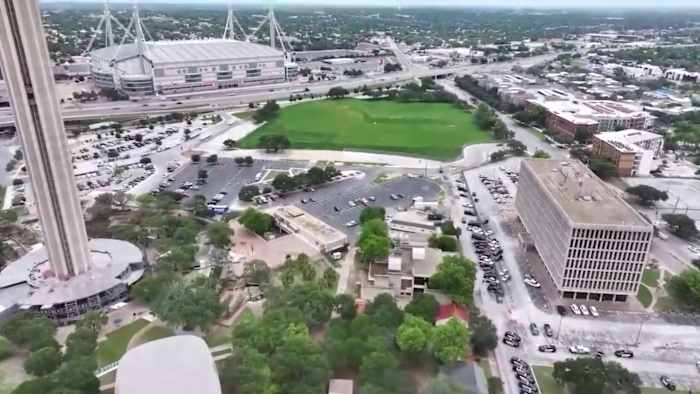
Speaking alongside SS&E CEO R.C. Buford, former Spurs player Sean Elliott said the team’s postseason run had strangers high-fiving each other and everyone wanting to talk about “our” team.
“So now is not the time for complacency. Now is the time to build on that energy,” Elliott said. “Thriving downtown. Real opportunity to revitalize the Eastside. Hotels, restaurants, small businesses filled with people coming together not just for Spurs games, but for concerts, conventions, big-time sporting events, college football and cultural games. That’s right there within our reach.”
McKee-Rodriguez, however, said the East Side is getting the “horrible end” of the deal, with residents being sold “competing visions” for the Spurs’ current home, the Frost Bank Center, “without the opportunity to meaningfully engage.”
He, Castillo, and Galvan all voiced concerns about the arena project before voting in favor of putting the city funding on the ballot.
“From the inception of Project Marvel, my position has been and will always be public money or public good,” Castillo said.
Mungia noted that while he had voted in favor of the term sheet last year, but he “just simply cannot explain to my folks, in my own way, that I would be against a public participation vote for this.”
The city still needs to negotiate final agreements with the Spurs, which council will also have a chance to vote on.
“I hope my colleagues are not as closed off to the idea of amending the nonbinding, non-executed term sheet,” McKee-Rodriguez said after the meeting, “and that ultimately what happens when a contract is signed is going to be something much more of a compromise than what exists before us today.”
In a memo to council members on Friday, City Manager Erik Walsh said a council discussion on their priorities ahead of negotiations is scheduled for Oct. 8.
Staff has previously said they hope to bring back a final deal by the end of the year.
Read also: