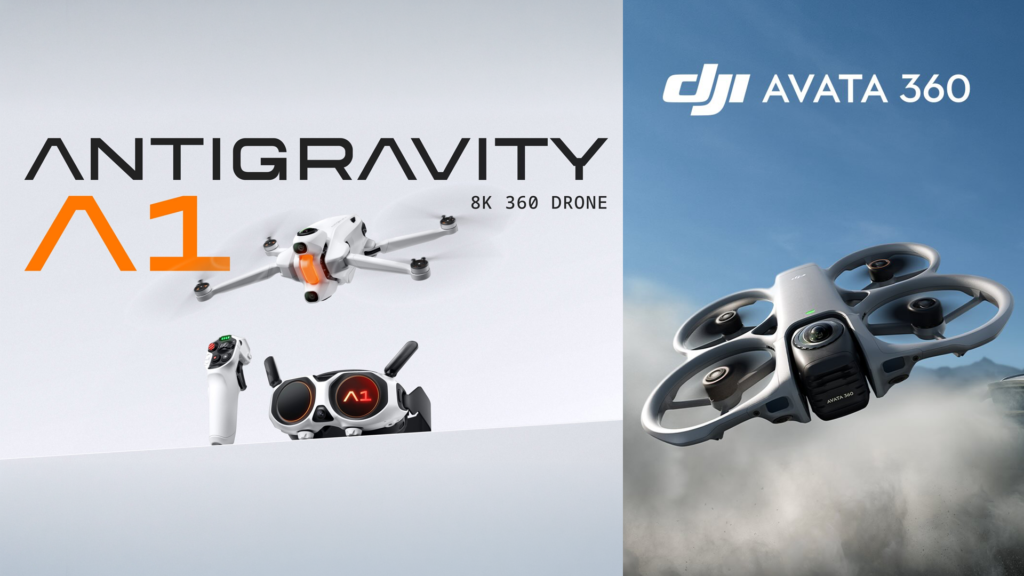
Relatively affordable drones with built-in 360° cameras are now a thing, with options from both DJI and a subsidiary of Insta360.
Affordable handheld consumer 360° cameras have improved leaps & bounds in recent years, with $500 8K HDR options available for over a year now from Chinese startup Insta360 and drone giant DJI, as well as from the American GoPro Max2. And while professionals could mount these or an array of wide-angle cameras to drones, that wasn’t practical for typical consumers and amateur creators. Insta360 also previously sold an attachment for drones, called Sphere. But any attached solution, no matter how streamlined, adds weight and thus negatively affects flight time and performance. It was also incredibly hard for these attached solutions to produce an undistorted 360° output free of any visible seams.
Last year, Insta360 spun up a new subsidiary brand called Antigravity, and in December launched Antigravity A1, the first fully integrated 360° camera drone.
As well as recording 8K 360° footage at 30FPS or 5.2K at 60FPS – footage that you can share with VR headset owners however you like – remarkably, the currently $1279 Antigravity A1 package actually comes with a headset featuring the same 2560×2560 micro-OLED panels you’d find in a Bigscreen Beyond, though a narrower field of view, around 70° horizontal and vertical.
The goggles receive a live 360° video feed from the drone via their protruding antennae, and with the headset’s rotational tracking you can look around from the drone’s position using your head, with very low latency. It weighs around a third less than a Quest headset, has a tethered battery to keep the weight off your head, and you can use it to watch your 360° recordings at home if you don’t already own a general VR headset.
0:00
Antigravity A1
Further, Antigravity A1 has a rather unique controller, also included in the box, a tracked device that leans into the VR-like experience by having you point with your arm where you want to fly. It’s essentially like being in a 3DoF VR flying game, the type you could have imagined on Oculus Go, except with photorealistic graphics and the obvious glaring difference that you’re actually flying around the real world.
In fact, Antigravity has leaned so much into this gamified approach that the company even has a feature to superimpose a player object onto a traditional FPV (non-360°) view of the live feed, such as a dragon or airplane. A truly unique idea, though it would be far more impressive if it could be superimposed onto the 360° feed, not just the regular FPV view.
0:00
Antigravity A1
In late March, just under two months ago, the drone market leader DJI launched a competitor to Antigravity A1, called DJI Avata 360.
DJI Avata 360 has a lower entry price for those who already own DJI controllers or goggles, at just over $400. Further, DJI’s drone can record 8K 60FPS and features a larger image sensor for superior footage, omnidirectional obstacle avoidance for easier flying, and prop guards for safety, while Antigravity A1 is meant only for outdoor use in open spaces. DJI’s drone also has a traditional single-lens mode, with the cameras in a mechanically rotating block.
| Antigravity A1 |
DJI Avata 360 |
|
| 360° Video | 8K 30fps 5.2K 60fps |
8K 60fps |
| Single Lens Mode | ❌ | ✅ (4K 60fps) |
| Sensor Size | 1/1.28-inch | 1/1.1-inch |
| 360° Photos | 55MP | 120MP |
| Weight | 249g (Standard battery) |
455g |
| Flight Time | 24 mins (Standard) 39 mins (High-Cap) |
23 minutes |
| Propeller Guards | ❌ (Exposed) |
✅ (Integrated) |
| Control Options | Motion Grip Only | Traditional Sticks or Motion Wand |
| Headset FOV (Horizontal × Vertical) |
70.5° × 70.5° | 38.8° × 22.4° (Goggles 3) 47.9° × 28.0° (Goggles N3) |
| Goggles Playback | Native 8K VR | 4K 60fps Max |
In other words, DJI Avata 360 is essentially the better drone – though I should note that it’s around double the weight, bringing it over the threshold for FAA registration.
0:00
Antigravity A1
However, it’s arguable that while DJI may have the better drone, Antigravity A1 is the better VR/MR experience, thanks to a better included headset.
The two DJI goggles that Avata 360 supports have a field of view of just 39°H×23°V and 48°H×28°V, respectively – considerably narrower than Antigravity’s. The chips in the DJI Goggles are also limited to 4K 60fps decoding, while Antigravity’s goggles have a more powerful chip for 8K playback.
0:00
Antigravity A1
In other words, flying the Antigravity drone will feel considerably more immersive, and you don’t even necessarily need a general VR headset to immersively watch the footage you record, though the even wider field of view of something like a Quest 3 would of course be preferable.
Regardless of these differences, the real story here is that any consumer or amateur creative can now record 360° drone footage with relatively little effort. We’re already starting to see the results on YouTube and Vimeo, and it’s a product category we’ll be tracking in coming years.
I’m back writing on UploadVR, and this article is one in a series of “catch up” pieces where I report on some of the interesting things that have been happening in the industry since my absence. And yes, VR Download is coming back very soon.