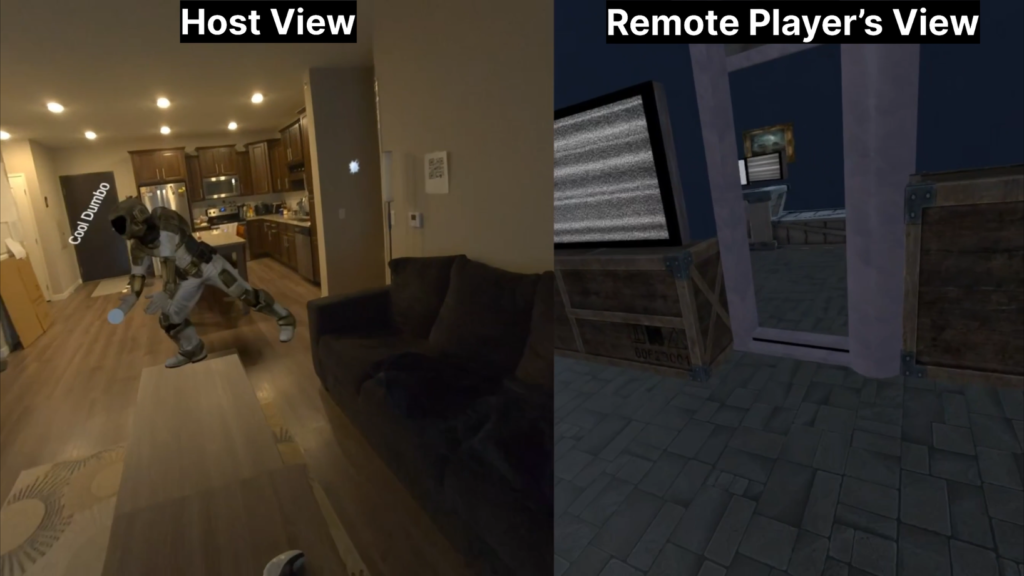
The developer of Hauntify is building a system to let a remote player join your mixed reality game via a VR representation of your home.
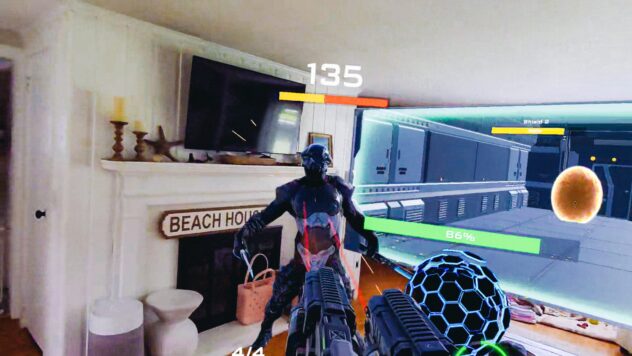
This system not only transforms the real-world objects in your play space into in-game assets, but also brings other players into your scanned rooms for remote shared space co-op.
We featured the new multiplayer mode for Hauntify at the UploadVR Summer Showcase. I had a chance to chat with VirtualGo’s CEO, David Montecalvo, at AWE (Augmented World Expo) about the technology his team developed to realize the multiplayer experience.
 David Heaney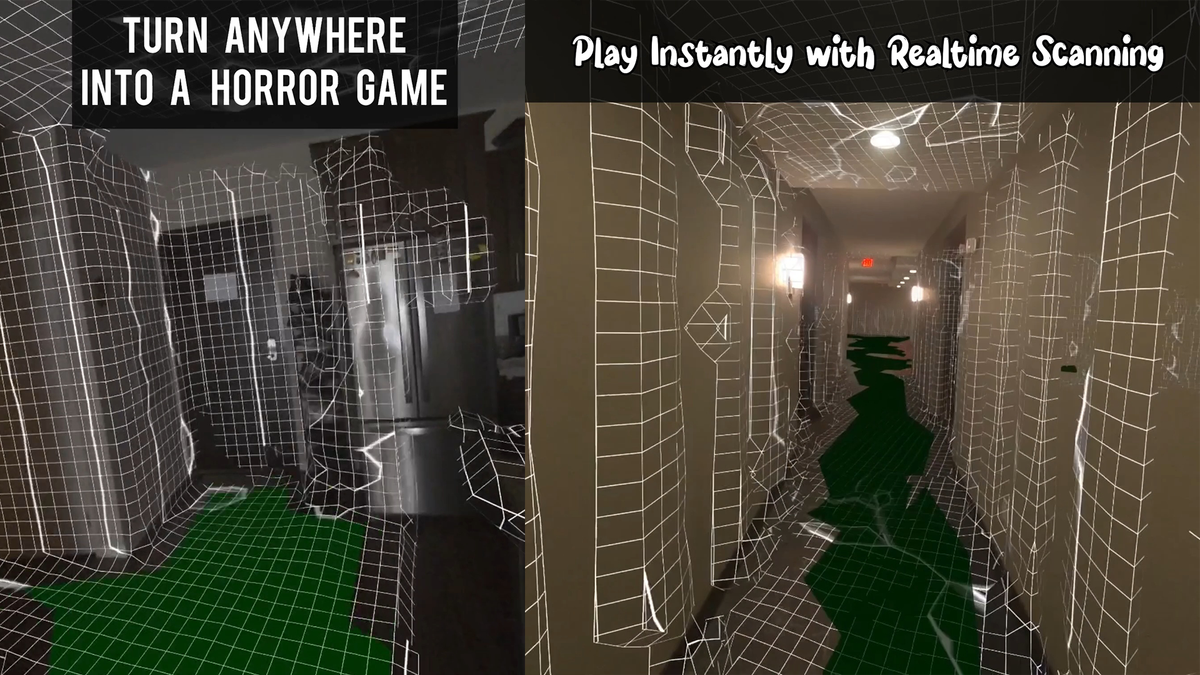
Scene understanding has been used to create transformative experiences in other games like Espire: MR Missions, Drop Dead: The Cabin: Home Invasion, and the upcoming Into the Dead: Crimson Heights. The difference here is the shared space co-op gameplay.
Per VirtualGo, remote Hauntify players will be able to enter the host’s scanned play space, seeing their transformed real world space in real time. I asked about the latency for the remote players and Montecalvo said it was negligible. I did not have a chance to test it live, a logistical impossibility in a convention setting, but the video and what this represents was my big takeaway.
Here’s the video:
0:00
Many people, including my colleague David Heaney, are on the record saying XR technology is still in its infancy, its Atari-level era. Hopefully, we can skip seeing landfills stacked with headsets in the near future. In terms of gaming, mixed and augmented reality both lag behind virtual reality, in part because the ‘transformative’ experiences of MR & AR have lacked both the visual fidelity heights virtual reality has seen and the true social experience of a shared world. VirtualGo’s system addresses the latter.
In VR, players have been exploring immersive worlds for years in apps like VRChat and Gen Alpha-focused experiences like Gorilla Tag and Animal Company. Similarly, asymmetric VR experiences like Acron allow players outside of a headset to still participate in immersive gaming.
MR and AR have been more limited. Portal-based experiences like Soul Assembly’s Last Stand and asset-driven party games like Grokit are perfectly fine, but each player is still in their individual play space, only seeing the game generated assets in their rooms. Co-location, the XR equivalent of couch co-op, does exist and developers like Resolution Games have utilized it in games like Demeo and Spatial Ops. That said, headsets are not so ubiquitous that the common household has multiple XR devices available. As such, that’s not a viable lane for developers to pursue as a primary feature at scale.
VirtualGo’s system removes that adoption requirement. We have already been joining our friends and family in fully realized VR spaces for years now. Being able to do the same in mixed reality is that specific corner of XR’s next step forward, especially if it opens up the potential for mixed reality user generated content.
0:00
Montecalvo says the system will not be limited to horror games and shooters, VirtualGo’s current projects. It will translate across any genre: cozy games, RPGs, etc. The multiplayer updates for VirtualGo’s Hauntify and shooters Mission Rift and FPS Enhanced Reality are planned for 2027.
All three of VirtualGo’s current projects, Hauntify, Mission Rift, and FPS Enhanced Reality are available on Meta Quest. There is a temporary AWE promo code VirtualGo shared to get 25% off each game: AWE2026-878AEE.