2025-26 Spurs Player Reviews: Stephon Castle
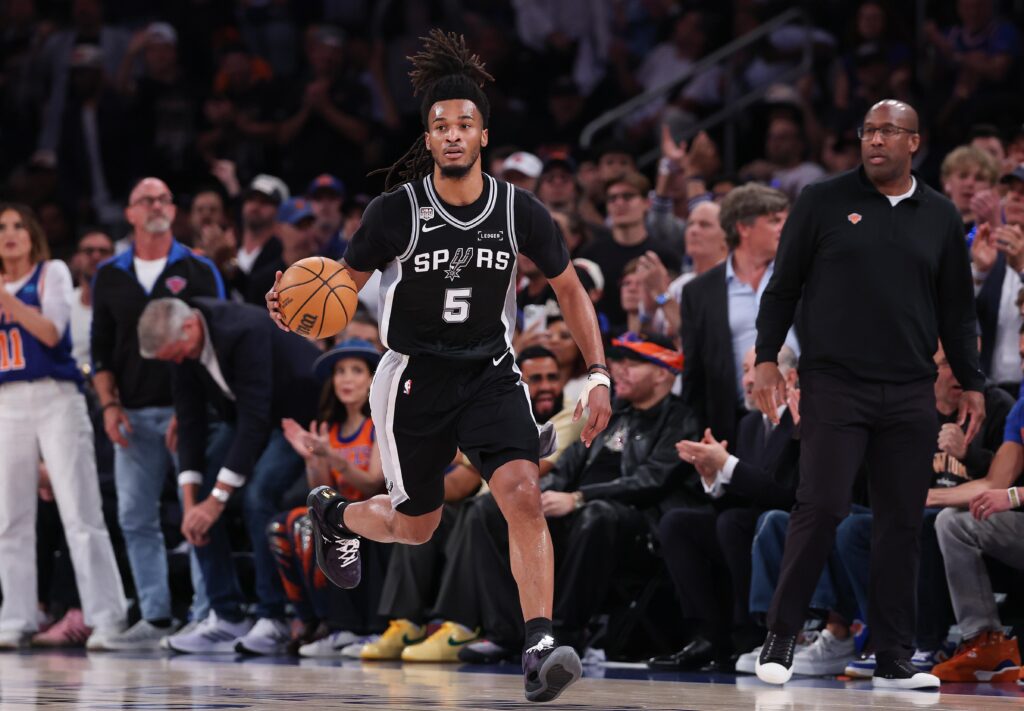
Welcome to Pounding the Rock’s 2025-26 player reviews! The series will look at the players who finished the season with the San Antonio Spurs on guaranteed contracts and who played consequential minutes and/or a vital role (so no two-way players because we hardly saw them this year, no players who were traded away, and none of the deep bench centers, since they were both irrelevant and are now all gone).
Stephon Castle
2025-26 stats: 68 games, 30 MPG, 16.7 points, 5.3 rebounds, 7.4 assists, 33.2 3FG%
Contract Status: 2 years, 22.7 million remaining (rookie deal)
Age: 21
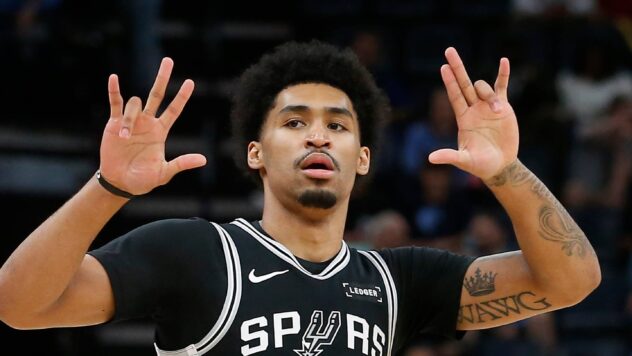
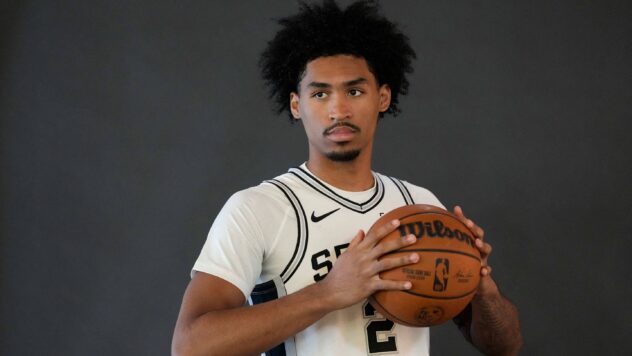
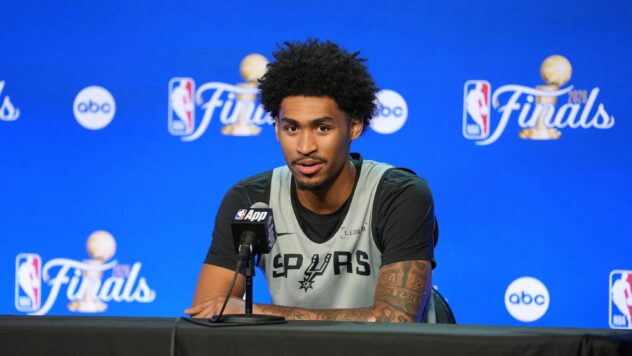
The Spurs had plenty of great individual performances in what was a complete success of a season, but Castle’s might be the most interesting one, both from a narrative standpoint and because of what it might mean for the future. The simple summary would be that he was fantastic in a major role, with some bumps along the way. But that role and those bumps are fascinating.
In the predraft process, Castle claimed that he wanted to be a point guard at the pro level after playing at the wing in college. There was some skepticism about his ability to do so, even though he handled the ball in high school, and some thought he was only saying it to fall to the Spurs and avoid being picked by the teams above them. But to the extent that a team with three ball-dominant perimeter players can have one lead guard, Castle was it for San Antonio this past season.
The sophomore made the most passes and led the team in touches per game, time of possession, and average seconds per touch in both the regular season and the playoffs. His 7.4 assists per game and his 19.6 assist points created also led the team and ranked him eighth in the league in both categories, excluding Ja Morant and Trae Young, who played 20 and 15 games, respectively. He was also among the leaders in all assist-related categories in the playoffs. Mitch Johnson gave Castle the ball, and Castle proved he knew what to do with it.
Equally true is that Castle was turnover-prone all season long, with only 10 players averaging more turnovers than him per game (again, removing guys who didn’t play much). Turnovers come hand in hand with having the ball a lot, but everyone above Castle had a higher usage. The problem was exacerbated in the postseason, as his assist-to-turnover ratio, which was mediocre at best in the regular season, got to worryingly low levels. There was also the 11-turnover game against the Thunder that got attention and made many wonder if Castle could survive without a second ball handler next to him.
While those issues were real, it’s hard to call Castle’s first season as a full-time point guard anything but a success, especially considering his age. And if those problems with turnovers persist, Castle’s amazing job guarding up to four positions suggests he can move off the ball some in the future to make room for a more natural floor general, as long as the shot continues to come along, as it did in 2025/26.
Looking ahead
In any other franchise, Castle’s destiny would have been defined by his success in the role he had in his sophomore season, but the Spurs have De’Aaron Fox and, much more importantly, Dylan Harper around. As mentioned, Castle can be productive in a heavy-usage on-ball role, but he might need to adjust to accommodate others who can also do the same to make San Antonio better.
His defense is already so good across positions (despite the occasional avoidable foul caused by overaggression) that Castle’s ability to move up and guard wings is not a question. Whether he can space the floor while playing shooting guard or small forward, on the other hand, is. Castle shot 33 percent from beyond the arc on low but acceptable volume, which shows he’s not a complete non-threat from outside. Still, that’s how opponents treated him. Over half of Castle’s three-pointers were of the wide-open variety, and he hit a mediocre 36 percent of them. He let it fly most of the time, but he had moments when he lost confidence and passed up the occasional shot. Going forward, the Spurs will need Castle to become a better shooter to slot in seamlessly alongside Harper. The pairing worked surprisingly well last season, but as Harper grows, he’ll want and need the ball more.
Even with some big holes in his game, which are expected of a 21-year-old, Castle seems destined to be a star. Because of the rookie scale, however, he doesn’t get paid like one for now, but he will be expensive soon. A max extension next summer, when he becomes eligible, seems almost inevitable, unless he takes an unlikely discount. The Spurs should be happy to pay him, as long as his third season goes as planned.
Top performance
Feb. 7 vs. Dallas Mavericks. 40 points on 19 shots, 12 rebounds, 12 assists, three steals.
With most of the players we’ve reviewed, the options for top performance weren’t many. It’s different with Castle, who had massive games in the regular season and the playoffs. I’ll take the easy way out and pick a 40-point triple-double, just the second in franchise history, but feel free to disagree.
Final grade: A-
Up next: Devin Vassell
Previous Reviews