What the Spurs can learn from Publius Decius, the Battle of Sentinum, and the 3rd Samnite War

There’s something almost grotesque in the way that the summer lingers in Texas. Where other regionalities have begun to cool in the 10th month of the annum, a feeling of freshly minted hell permeates throughout the beef state, with 90-degree temperatures still in reach.
Fall is here, though, make no mistake. And with it, the reminder of just how badly Julius Caesar cocked up the Julian Calendar. How on earth is October not the eighth month of the year? It was in the previous Roman calendar!
I’d ask who to blame, but history has made it pretty clear who bears the responsibility for such an inexplicable error. Fortunately, he was subsequently used as a fleshy pincushion by a group of peers who were also upset about the calendar.
Or, at least, that’s what Brutus told me. And Brutus is an honorable man.
In any case, November is almost here, and those are not the Romans that we’re looking to discuss. Building on last season’s classically-themed season preview, we’re once again looking at how best to apply the lessons of Roman imperial conquest to the sport of professional basketball, calendars be damned!
But first, let’s go over some significant roster developments:
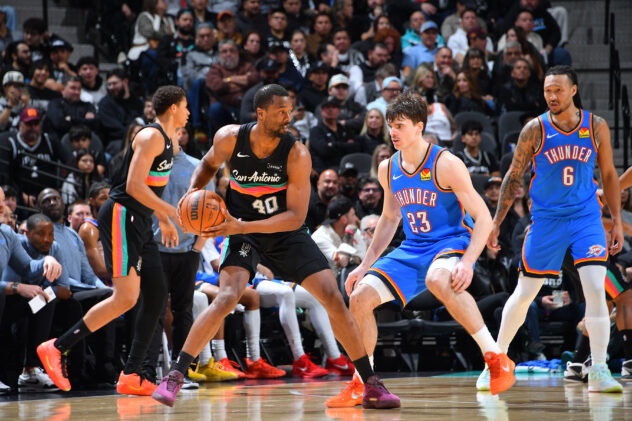
- The free-agency and trade additions of Luke Kornet and Kelly Olynyk have improved San Antonio’s big man depth to such an extent that they have four players with considerable experience playing center for the first time since the end of the Duncan-era, and their first trio of seven-footers since 2019.
- The addition of Dylan Harper with the 2nd pick in the NBA draft, leaves the Spurs with three players capable of running the point at (or near) a starter level of quality for the first time since 2021.
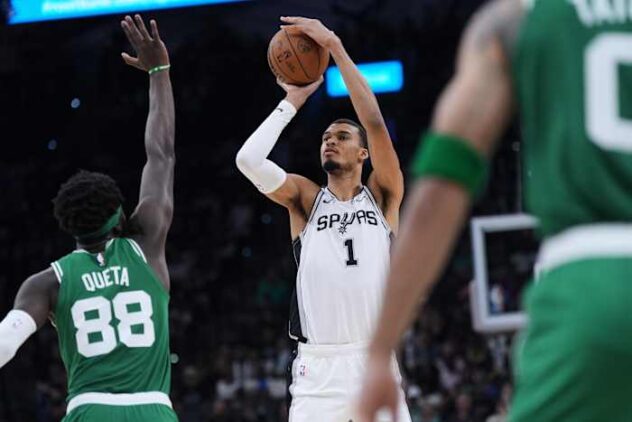
- A largely healthy offseason for Victor Wembayama and Devin Vassell has both players in great shape and looking more aggressive than ever.
- After navigating most of last season in an interim role, Mitch Johnson has officially assumed the role of head coach after Gregg Popovich’s return to the front office. His hiring of defensive maestro Sean Sweeney and the up-and-coming Austin Spurs head coach Scott King gives San Antonio their youngest coaching staff since the days of James Borrego, Ime Udoka, and Becky Hammon.
- The addition of Carter Bryant with the 14th pick has given the Spurs their most depth at the forward position in a very long time, with Jeremy Sochan, Keldon Johnson, Julian Champagnie, Harrison Barnes, and Lindy Waters III all potentially vying for minutes in the regular season.
Those are not small changes for this roster, though their cumulative effect has been somewhat ignored and underrated by national media members.
Over the past couple of seasons, the Spurs have been perilously thin at the point and in the post, with success hinging on season-long health at those positions. Injury bug or no, betting on that sort of thing is always a gamble in pro sports. And as of late, it’s been a gamble the Spurs have been on the losing end of.
That’s a trend that I expect to reverse itself this season, as the Silver and Black finally have depth more reminiscent of a playoff regular.
The Spurs are sure to be tested, though. Already, they’re starting the season with minor injuries to Sochan, Olynyk, and De’Aaron Fox. Much as I hate to say it, more are sure to come. However, with 2-3 rotation caliber players at each position, injuries may turn out to be a minor blessing, possibly giving the rookies more developmental playing time than they might otherwise have gotten — experience that’s likely to be harder and harder to come by for rookies in the years to come.
So, what are the hurdles facing the team that necessitate a reflection on the history and principles of Romanic conquest? The kind of hurdles that go beyond improved numbers and a change in command.
A hundred and twenty-five years before Hannibal crossed the Alps, the Romans embarked on a series of conflicts that represented the first significant expansion of their fledgling republic. Having slowly and gradually gained territory through a number of smaller conflicts and alliances, the Romans were keen to cut off any and all direct avenues to invasion.
It was a reasonable concern for a nation that had spent years being attacked by the Etruscans (whose monarchy they overthrew to assert independence), and that had seen Rome sacked by the Gauls not even a full 50 years before.
The Romans, more or less content to attend to their own development and controlling only a portion of Italy and its larger economy, had failed to anticipate the invasion and suffered a series of defeats that eventually drove them through the very gates of their own capital city and forced them to pay tribute/ransom to the invading Gauls.
Rapidly, the Romans rebuilt themselves and their armies, forcefully united/conquered their minor Italian allies, and set their sights on their greatest rival: the Samnites.
Once their allies against the Gauls, the Samnites had taken advantage of Rome’s previous woes and had begun to creep into their fertile lower plains. They assumed that the Romans were in decline as a power. They could not have been more mistaken.
Having lain low for long enough, the Romans beat back the Samnites with ferocity, pausing only once to assert their dominance amongst their own allies, and taking more territory with each subsequent war over the next 53 years, until finally they met the last significant opposing force at the Battle of Sentinum.
For much of the war, the Samnites had enjoyed an advantage in numbers. Now, they had allied themselves with Rome’s former enemies in the Etruscans and the Gauls and took the field with an army of 50-60,000 men.
The Roman force was estimated at 40,000.
Here, at last, after decades of warfare, was the final test of mettle. With victory, the Romans would control all of the Italian peninsula, setting the stage for centuries of expansion to come.
With defeat, the kind of military setback that would all but end the hopes and ambitions (and perhaps existence) of the Roman Republic.
Two years before, the Romans had elected a consul after rumors of a Samnite and Etruscan alliance had reached them. Their choice was an experienced military commander by the name of Quintus Fabius Maximus Rullianus (grandfather of Quintus Fabius Maximus Verrucosus – ‘The Cunctator’), who refused the appointment on grounds that he was ineligible, and only relented on the condition that his former co-consul and close friend Publius Decius Mus also be elected alongside him.
It was a sensible request, and one the Romans were happy to honor. Both men were heroes of the 2nd Samnite War, having co-commanded together with such success that they had ended the conflict with a series of forced truces.
Leading two separate armies, they had worked independently against the Samnites and Etruscans, yet in near-perfect lockstep. Convinced that such teamwork would be needed once again, Quintus Fabius made a decision that would ultimately affect the fate of the war in a near-prophetic fashion.
They were very different men. Quintus Fabius was (much like his eventual grandson) a commander of great caution and calculation, and talent for politics. Publius Decius, on the other hand, was aggressive and daring, and descended from a long line of military men who were known for sacrificing themselves on the field of battle. Each was highly successful, and in spite of those differences, held the other in high esteem.
Once again, they split their armies. And, once again, they cut through the opposition with relative ease, until they ultimately reunited on the plains of Sentinum.
For two days, the Romans planned their strategy against the superior force until finally charging the Samnite army. And for a moment, their plan appeared to be working. Quintus Fabius fought more defensively, in an attempt to pin half of their enemies in a vice of attrition and keep them from assisting the other half of the army that Publius Decius was leveling with his full force of ferocity.
Decius ordered a cavalry charge, which drove the Samnite cavalry back twice, and so punctured their ranks that the Romans all but split their infantry lines in two.
They had, however, failed to consider the mobility of the Samnite chariots, who had extricated themselves from Fabius’ vice, and promptly counter-charged Decius’ cavalry, breaking open the Roman infantry lines instead.
It should have been a fatal moment. The Roman left was in disarray, and due to the success of their previous strategy, Quintus Fabius was in no position to help. Even the smallest of collapses would almost certainly allow the Samnites to flank to Roman army, all but guaranteeing defeat.
It was then that Publius Decius, General and Co-Ruler of the Roman Republic, donned his armor and made his way to the front lines, bellowing the Devotio, a prayer to the Roman deities to accept his sacrifice in battle in exchange for the victory of his people, just as his father had done 40 years previously.
In doing so, he united his remaining men and reformed the Roman left long enough for two of Quintus Fabius’ reserve units to arrive and assist.
Realizing that the Samnites had over-committed in their counterattack, Fabius recognized that they had subsequently weakened their own right, and called for a cavalry charge on that side that broke the Samnite flanks and split their forces in twain, effectively ending the battle and the war.
All told, the Samnites lost 20,000 men. The Romans, fewer than 9,000, plus one heroic General.
And as for the San Antonio Spurs?
Well, the reality is that the San Antonio Spurs will never be able to rise to contender status without some kind of Devotio of their own.
The team is, without a doubt, the deepest it’s been since LaMarcus Aldridge and The Forward Who Shall Not Be Named briefly struck fear into the hearts of the Golden State Warriors in the Western Conference Finals.
That depth, however, creates a necessity of sacrifice. A sacrifice that will be required, whether by trade, or playing time, or in some other fashion, in order to birth the beginning of the dynasty that so many envision as a future for Victor Wembanyama and company.
This should not come a shocking news to those of us who spent years with our eyes on the previous San Antonio dynasty. We’ve witnessed the sacrifices that came before.
The playing time and starting unit concessions by Manu Ginobili, the trades of beloved players like George Hill, Malik Rose, Fabicio Oberto, and Bruce Bowen to reinforce weaker areas of the roster, the cutting of respected vets like Stephen Jackson to pick up better-fitting role players like Boris Diaw, the endurance of losing for the sake of the franchise’s future by Gregg Popovich.
The Spurs have patched up many of their weaknesses this off-season. After ranking in the bottom 3rd of most rebounding statistics, they signed one of the better rebounding bigs (by rate stats) in Luke Kornet, drafted an almost surefire point-guard of the future behind Fox and Stephon Castle, and added long, rangy shooters in Kelly Olynyk, Lindy Waters III, as well as (hopefully) up-and-coming sharpshooters in Riley Minix and Carter Bryant.
The time has come. The assets have been hoarded, the team has been reloaded, and all that’s left is to find out what price there is still to pay. The depth is there, the talent is there, but who will have the courage to become San Antonio’s Publius Decius?
Only time will tell.
It’s been an off-season of bold talk from Wembanyama and other Spurs. No longer are the interviews about rebuilding and experimentation. War has been declared by a roster longer on aspiration than experience.
To Victor Wembanyama, now focused on asserting his place in the NBA hierarchy and legendarium, I offer the same advice that Maester Aamon gave to John Snow (and to his own brother Aegon V) upon assuming his role as Lord Commander of the Night’s Watch:
Kill the boy, Victor. Kill the boy, and let the man/dynasty be born.
The season is long and treacherous. Attrition is coming. But if these Spurs are able to find the steel in their bellies to do what must be done – to sacrifice as needed and endure the cost, questions of contention will be no more, and questions of empire will abound.
Playing You Out – The Theme Song of the Season:
Time Has Come Today by The Chambers Brothers