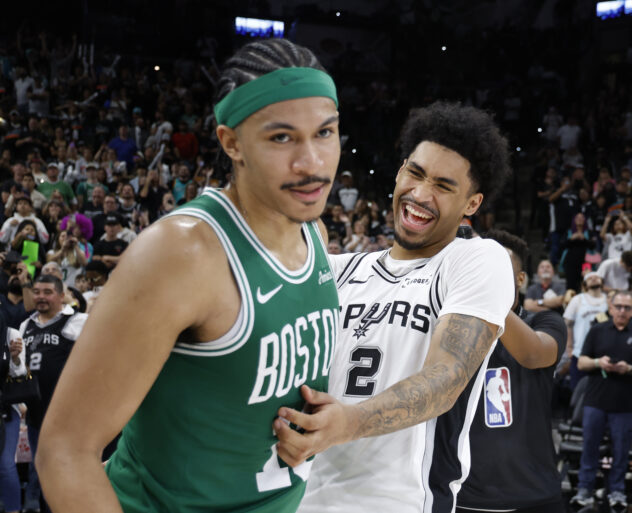
Time may be running short for Branham and Wesley to prove themselves to the Spurs
As the Spurs get deeper, two of their three third-year players have plenty to prove if they want to stay long-term.
For the most part, the San Antonio Spurs have done what fans wanted them to do in the draft and free agency. They drafted their potential point-guard-of-the-future in Stephon Castle and added veteran help at their weakest positions — point guard and forward — in Chris Paul and Harrison Barnes, who should also both help with the Spurs’ outside shooting and playmaking woes.
Just those additions alone have created some intriguing rotation discussions when looking ahead to next season. We already know that Paul will be the starting point guard, which means Tre Jones will be his backup, but how else will the starting lineup change? Julian Champagnie, who survived being waived to make room for the Barnes trade, will likely be moved to a bench role, but who will replace him? Will Castle immediately get thrown into a starting role off the ball, or will Barnes be a starter?
Whatever happens, the veteran additions certainly make the Spurs much deeper than last season, with a second unit presumably led by Jones, Keldon Johnson, and Zach Collins (call me an optimist, but I have faith he will return to his 2022-23 form) plus some combination of Castle, Barnes or Champagnie, depending on how the starting lineup shakes out. Not to mention, there’s still three open roster spots to work with, which the Spurs could use to bring in more depth or re-sign renounced players such as Sandro Mamukelashvili, Charles Bassey or Cedi Osman.
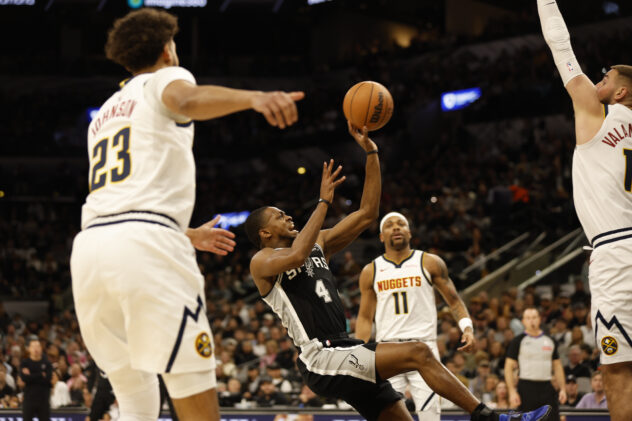
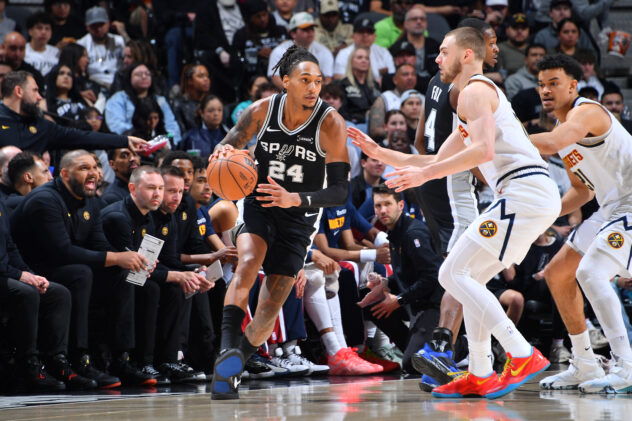
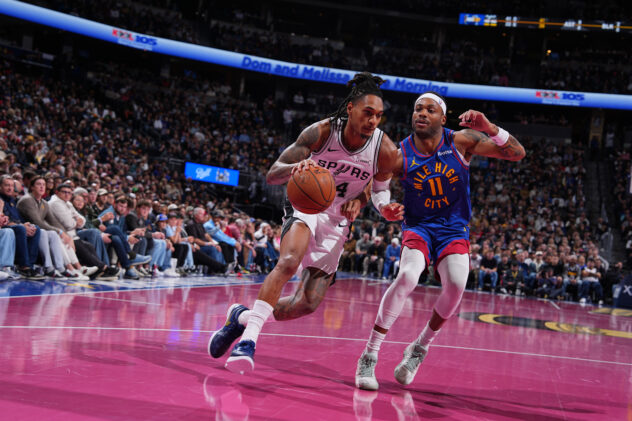
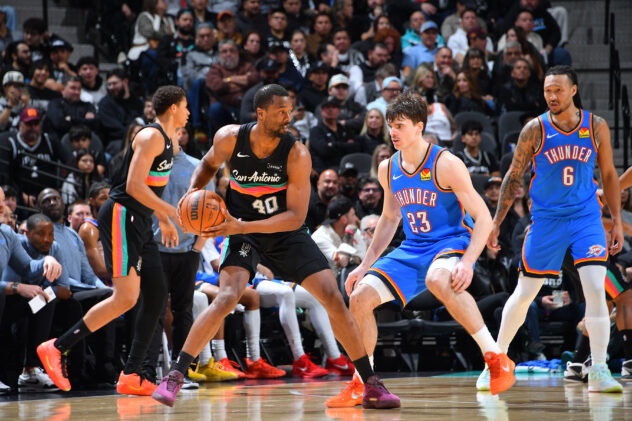
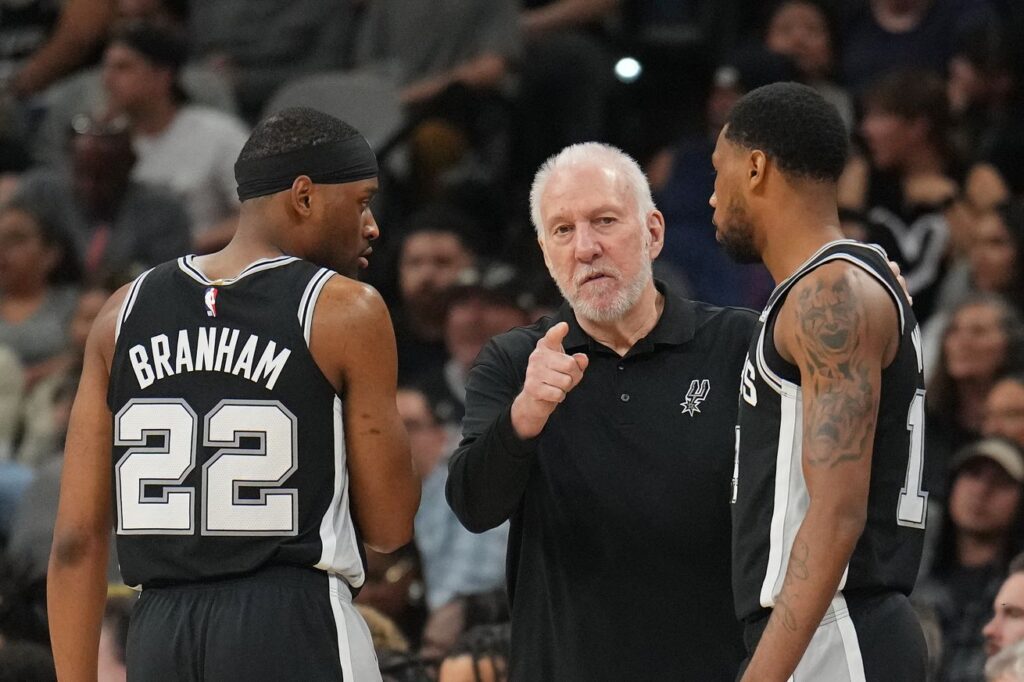
That being said, I have found myself guilty of forgetting a couple of names when speculating about the potential rotation next season: Malaki Branham and Blake Wesley. While the latter has been in and out of the rotation his entire two-year career, the former has usually been in it, both in starting and bench roles. However, the fact that Branham in particular keeps escaping my mind when thinking about the rotation may be telling.
In both of Branham’s two seasons, he got out to a slow start before turning things around, but last season still represented a bit of a sophomore slump for him. Although his three-point shooting jumped from 30% to almost 35%, the rest of his numbers went down, including his overall shooting numbers, points per game, and minutes played. He’s not much of a playmaker, averaging just 2 assists per game, and for being drafted as a shooter, he has been more a part of the Spurs’ maligned offense the last two seasons rather than a solution.
As for Wesley, he got a pass for his rookie struggles after suffering a knee injury just two games into his career, but anyone who hoped to see more in his second season was left disappointed. With a poor 2023 Summer League showing being a precursor, nearly all of his numbers dipped in the regular season as well, with the only notable rise being in his two-point shooting (which could only going up after a disastrous rookie season, where he was in the bottom percentile of the entire league around the rim). He remains raw and undisciplined, but his athleticism and defensive instincts do provide glimmers of intrigue.
Under normal circumstances, we would be assuming that both Branham and Wesley would get their requisite four years to prove themselves, then go from there. Unfortunately, due in part to a shifting timeline, one or both of them may not get that full opportunity. With the Spurs lucking into Victor Wembanyama, the rebuild has been sped up, and the additions of Paul and Barnes show that while the Spurs aren’t overreacting, they are speeding things up a bit, and this won’t be an entirely organic rebuild.
Add the fact that the Spurs could have anywhere from two to four first round picks next year (their own and the Hawks’ pick, plus potentially the Bulls’ top-10 protected and Hornets top-14 protected) as well as two picks in 2027, and they could very quickly run out of roster spots for any young players who haven’t proven themselves. Right now, of all the players still on rookie contracts, Branham and Wesley find themselves closest to that precarious position.
The Spurs have right up until 24 hours before the 2024-25 regular season starts to exercise the fourth-year team options on them and Jeremy Sochan, and while Sochan is a safe bet to be picked up, one or both of Branham and Wesley may not be so lucky. It has been noted that the Spurs appear to be operating on a one-year time line, with the assumption being that they want to keep the books clean for a much deeper 2025 free agency class.
The addition of Barnes, who has two years left on his contract, puts a $17 million dent in their cap space next summer. If they don’t pick up the 4th year options of Branham and Wesley, that would be nearly $10 million in cap space saved for the 2025-26 season. Even if the Spurs do pick up their 4th year options, it’s hard to imagine them working on extensions for either player without a big leap in production. Otherwise, they would become free agents in 2026.
None of this is to say the Spurs should be giving up on either player. They each bring a unique skillset and still have another level they could unlock, but when the time comes to start trimming the roster to make room for upgrades, their weaknesses may be hard to overlook. Neither has quite proven to be a reliable point guard (should Jones move on next summer), and neither are good enough shooters to help spread the floor at shooting guard. They also lack the defensive discipline and potential upside of someone like Castle or they may pick in next year’s much deeper draft.
Of all the Spurs’ young players, the pressure is on Branham and Wesley to prove themselves more than anyone else, and this upcoming season might be their last chance to earn a spot in the Spurs’ future plans.