How the Spurs’ championship teams still resonate today
One other team that manhandled a Spurs squad to get to the finals is also mentioned…
Neal Paine of ESPN did something this week that’s near and dear to my heart: trying to compare this season’s conference finalists to championship rosters that have ascended to the top of a particular season’s mountain. Paine starts with this lovely tagline: “Sometimes, to see into the future, you need to look to the past,” and then proceeded to supply the readers a) who this season’s team is most similar to, b) the particular reason(s) why that is, and c) which component is missing on the 2024 version of that team type.
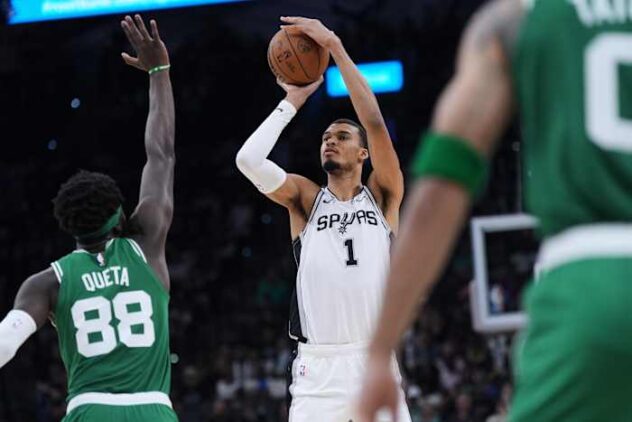
This season’s Boston Celtics ended up being most similar to… the 2014 San Antonio Spurs! This is mostly in part due to a “potent offense.” Additionally Paine states quite awesomely:
There’s a good case to be made that the Spurs played the sharpest NBA Finals in modern history when they beat LeBron James and the Miami Heat in 2014. In that five-game series, San Antonio posted the best net rating (+17.2) and second-best offensive rating (118.5) of any team in the Finals since at least 1997, burying Miami under a landslide of efficient and unselfish team basketball… In the style of the 2014 Spurs, who rained down a barrage of 3-pointers on the opposition, Boston easily leads all teams in 3s per 100 possessions; the Celtics also have five players with an assist rate in the double digits but below 30%, spreading the ballhandling around just like San Antonio did in the 2014 playoff.
The big question ended up being “Who is their Kawhi Leonard,” and the majority of us might quip “they don’t have one because everyone’s bought in!” (sic)
Then the Minnesota Timberwolves are assigned to … the 2003 San Antonio Spurs! Paine makes that attribution because of the Spurs’ “suffocating defense.” He puts Minnesota in pretty rarefied air:
… it should come as no surprise that the most similar champions to Minnesota are a bunch of defensive juggernauts, including three of the most exceptional modern examples of teams winning with defense: Tim Duncan and the 2003 Spurs, Kevin Garnett and the 2008 Celtics, and Ben Wallace and the 2004 Detroit Pistons. That’s the kind of neighborhood this Wolves team will be moving into if they win the title.
The biggest question then becomes whether that “defense-over-offense formula” ultimately would get them to the finish line victorious.
Unfortunately, Paine veered in different directions with Dallas and Indiana. The Mavericks were mostly compared to… the 1995 Houston Rockets, which steamrolled the Spurs in that ill-forgotten Western Conference finals series. The similarity had to do primarily with Dallas’ star power. And in the words of Forrest Gump, “that’s all I have to say about that.”
Unfortunately, the Pacers ALSO were most similarly compared to… the 1995 Houston Rockets! (I looked over and over for some editing mistake, but couldn’t find it). Paine admits that it’s a bit of a reach because:
The truth is that practically no modern champ is really all that similar to the 2024 Pacers. During the regular season, Indiana won only 57.3% of its games; the team also ranked second in offensive rating but 24th on defense. This is a historically lopsided build for a team trying to win a title, so it’s incredibly hard to find parallels from NBA history. The only other team to win it all after a regular season spent winning as little as 57.3% of their games? You guessed it, the 1995 Rockets; but even they weren’t as extreme in their reliance on offense to power a title run.
Pounders: What do you think about author’s linkage of this year’s title favorites to prior championship teams? If they’re not correct, who would you correlate them with?