Around the NBA: Houston’s liftoff, Memphis’ bounce back, and Detroit’s rising star
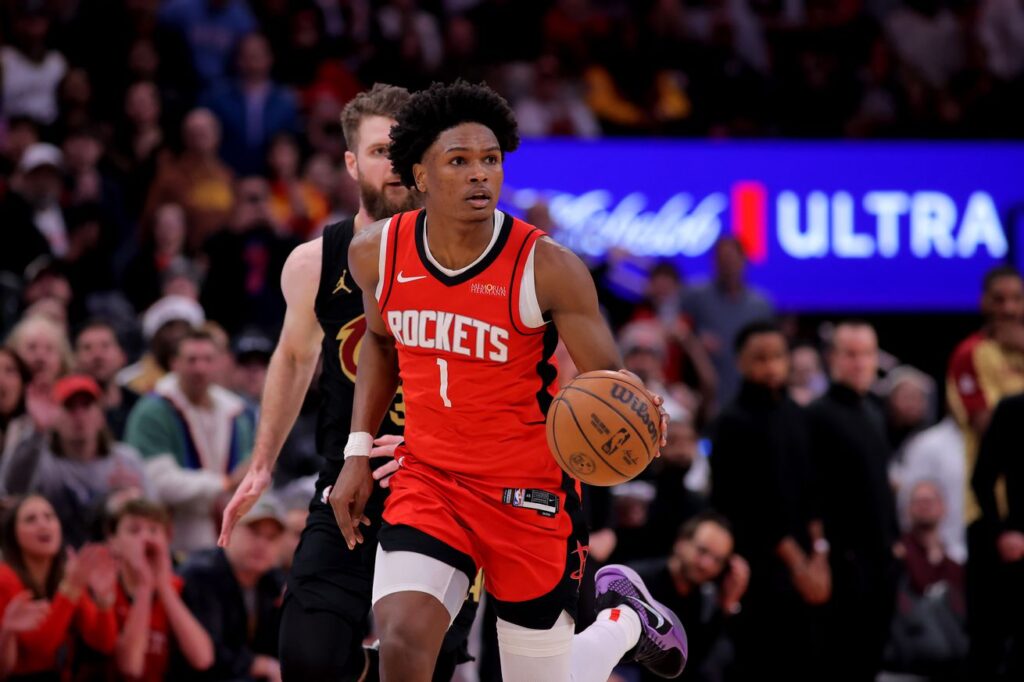
It’s time to analyze three feel good teams of the season.
Many young teams have risen to prominence this season.
The Rockets continue to accelerate, the Grizzlies are predators again, and the Pistons’ malfunctions have been fixed. They’ve all done it in different ways, but there’s no denying that they all share a bright future.
So, it’s time to analyze how each team has found success, beginning in H-Town.
Houston, we have liftoff
Even the most optimistic Rockets fans didn’t expect the team to be this good, this soon.
Currently the second seed in the West, Houston is on pace to win over 50 games and could legitimately make it to the second round of the playoffs. Their +6.9 net rating is 6th league-wide, and the Rockets are one of just six teams with both a top-10 offense (115.7, 10th) and defense (108.8, 3rd).
One of the biggest drivers behind their success has been the play of Amen Thompson. Defensively, he’s a unicorn who’s fast and agile enough to shut down guards while also having the length and vertical pop to make life difficult for bigs. Consider this: Amen has a 1.7% block rate (98th percentile) and 1.9% steals rate (84th percentile), making him a unicorn that’s elite in both areas.
Looking at the tape, it’s easy to see why. Billed as a generational athlete, he’s lived up to the hype and then some. In the first play below, Amen stays in front of Nickeil Alexander-Walker using his lateral agility. His balance and strength allow him to be in position to poke the ball away, and no one’s catching up to any Thompson when they’ve got a free runway. Then, the second play shows just how freakishly fast he can recover, somehow not only contesting Ant’s shot, but blocking it too.
— Bill Huan (@bill_huan) January 25, 2025
It’s not hyperbole to say that Amen is the best athlete currently in the NBA. While players like Zion and Ja might have flashier dunks, Amen’s functional athleticism is something that I’ve never seen before. He moves like a CGI character in an animated film and seems to glide whenever he’s airborne.
— Bill Huan (@bill_huan) January 25, 2025
Offensively, I’m very skeptical that Amen will ever develop a reliable outside shot. Even so, he can do everything else at a high level and forces the defense to guard him by either handling the ball or constantly cutting to create space. He also knows his strengths and weaknesses and sticks to what he’s good at. For example, rather than take an ill-advised long two or drive to the basket against LeBron (and AD in help position), Amen instead chose to run a quick pick and roll to momentarily confuse the defense and open up a lane.
— Bill Huan (@bill_huan) January 25, 2025
Amen’s self-awareness is evident in his shot selection: this season, only 13% of his shots have come from three (0 percentile) while an astonishing 56% of them have been taken within four feet of the basket (98th percentile). He’s also making an impressive 73% of those rim attempts (86th percentile), as he utilizes his athleticism and soft touch to finish layups.
— Bill Huan (@bill_huan) January 25, 2025
I don’t think Amen will ever be the top player on a championship team due to his broken jumper, but he could become an actualized version of Ben Simmons — a player who’s good enough to be an All-Star even without a reliable shot. Pair that with someone who’s already All-Star caliber in Alperen Sengun and the Rockets have a strong core that should only get better.
Houston still needs to find The Man to become a top-tier contender, but they’re well positioned to execute a blockbuster deal given their plethora of draft picks and young talent. So even if the Rockets exit early in the playoffs this year, they’re still set for the future.
The Southwest division will be a bloodbath for years to come.
The Grizzlies are biting back
Another feel-good West team is Memphis, who’ve bounced back nicely after being decimated by Instagram live injuries last year. Unsurprisingly, their defense is once again elite (110.5, 5th), but the Grizzlies have somehow developed into a top-5 offense (119.2), too.
On the surface, not much has changed. Memphis’ tenets of grabbing offensive rebounds (32.6% OReb rate, 2nd) and prioritizing running in transition (17.9% frequency, 1st) remain the same. However, they’re currently 13th in half-court offense (98.3), which is the first time the Grizzlies have cracked the top 20 in a decade.
Memphis’ break-through is twofold. First, they’re moving the ball more: the Grizzlies are averaging 291.5 passes made per game (10th), a big jump from the 273.5 (21st) they averaged two years ago when they were last healthy. As a result, Memphis is shooting just under 23 open threes per game (3rd) — a large jump from the 18 they created in the 2022-23 campaign. Naturally, this has made the team more efficient, as they’ve increased their three-point accuracy from 35.7% (22nd in 2022-23) to 37.8% (8th this season).
More importantly, Jaren Jackson Jr. has made an offensive leap. Forced to create his own shot on a depleted team last year, JJJ drastically improved as a playmaking/scoring hub, and that’s carried into this season. Previously, one of JJJ’s weaknesses was his lack of passing ability, but he set a career-high assist percentage of 13.3% last year (73rd percentile) when his previous high was a meager 7.4%. He’s currently at 11.1% (51st percentile), but that’s a result of Memphis having a healthier team rather than a playmaking drop-off from JJJ.
Rather, he’s focusing more on creating his own shots, which usually come in the form of drives. JJJ’s now strong enough to get to the paint at will, pushing opposing bigs back to create space to get off his favorite shot: a little floater from just below the foul line.
— Bill Huan (@bill_huan) January 25, 2025
If he’s unable to overpower his defender, JJJ is also agile enough to spin and hit the floater with either hand.
— Bill Huan (@bill_huan) January 25, 2025
JJJ is averaging 9.8 points this season off of drives alone — the 9th highest mark league-wide. Impressively, those points are coming from just 7.5 field goal attempts (1.3 points per attempt), making his drives one of the most efficient plays in all of basketball. JJJ’s true shooting percentage of 59.1% is also above league-average and a vast improvement on the 55.2% he mustered last year, proving that he’s now a high-volume and high-efficiency offensive player.
Impressively, he hasn’t taken a step back defensively even with the larger scoring burden, remaining one of the most versatile defenders in all of basketball. In fact, JJJ’s rim protection has somehow improved: opposing players are shooting -14.7% worse within six feet of the basket when JJJ’s the primary defender (63.2% expected, 48.5% actual), which is the largest discrepancy in the entire league, Wemby included. He consistently makes the opposition look foolish when they challenge him at the rim. Do players forget that he’s used to contesting Ja freaking Morant in practice every day?
— Bill Huan (@bill_huan) January 25, 2025
Simply put, JJJ has developed into one of the most dominant two-way forces in the league and has undoubtedly been the Grizzlies’ best player this year. Memphis now has two legitimate offensive fulcrums in him and Ja, making them a legitimate threat to go on a deep playoff run.
Wait, the Pistons are competent again?
With all due respect to Memphis and Houston, the league’s best story this year has been the Pistons. Following a historically bad season when they only won 14 games, Detroit is currently over .500 and occupies the sixth seed in the East.
The biggest difference is that, well, their best players are actually playing. I’m not sure what blackmail Brooklyn Nets legend Killian Hayes had on Monty Williams, but having him start over Jaden Ivey last year was one of the most baffling coaching decisions in recent memory. Detroit could’ve doubled their wins this year by simply playing a normal rotation, but off-season additions and internal growth have contributed to their breakout, too.
Arguably the worst shooting team in the league last year, the Pistons improved their spacing through the additions of Tobias Harris, Tim Hardaway Jr., and Malik Beasley. 37.9% of Detroit’s shots now come from three (17th) when that number was just 32.7% last season (29th). By having at least two of Harris, THJ, and Beasley on the court, the Pistons have also increased their three-point percentage from 35.6% (24th) to 37.2% (13th). The improved shooting has helped Detroit increase their offensive efficiency from 28th (109.2) to 18th (112.5), and that’s only on one side of the ball.
Defensively, they are now ranked 13th (113.8) when they were 25th last year (119.4). Again, shot selection is key: Detroit is only letting 28.4% of opposing shots come within four feet of the basket, which is a vast improvement on the 33.9% (19th) they conceded a year ago. Simply put, the Pistons aren’t letting the opposition shoot from the most efficient areas on the court, as they’re also top ten in the lowest percentage of opposing shots that come from three.
With all that said, Cade Cunningham is the biggest factor behind Detroit’s success. The former #1 pick shouldn’t just be a lock to make the All-Star game, but he should be in All-NBA discussions too.
This season, Cade’s averaging 24.9 points, 6.5 rebounds, and 9.4 assists — all career highs. He’s turned into a mid-range maestro even without an explosive first step by often decelerating on a dime to create separation.
— Bill Huan (@bill_huan) January 26, 2025
Cade’s now shooting a robust 47% from mid-range, ranking in the 72nd percentile. Interestingly, he also has a throwback post-game, as he often likes to back down smaller guards before finishing with a soft hook.
— Bill Huan (@bill_huan) January 26, 2025
Moreover, Cade’s playmaking has taken a leap. He throws beautiful underhand lobs to bigs in the pick-and-roll while timing it perfectly so that his target has an open dunk.
— Bill Huan (@bill_huan) January 26, 2025
The most impressive part, though, is his anticipation. Many of Cade’s passes aren’t difficult, but that’s strictly because he’s patient and doesn’t force things. In the clip below, he sees that Isaiah Stewart has a mismatch down low, but instead of forcing the ball to him early, he takes an extra dribble to open up a better passing lane. Before throwing the pass, Cade also manipulates the defense using his eyes by briefly glancing towards the shooter on the weak side so that Toronto’s help man is completely out of the picture.
— Bill Huan (@bill_huan) January 26, 2025
The next step in Cade’s evolution would be to become a better finisher. Currently shooting just 55% (15th percentile) within four feet of the basket, it has resulted in his true shooting percentage (55.1%) being slightly below league average. Still, it’s a skill that can be improved, and Cade has the intangibles and basketball IQ that can’t be taught.
With other young talent like Ivey and Ausar Thompson still developing, Detroit’s future is bright. Even if they’re still far from being contenders, having a cornerstone player and a competent team is nothing to scoff at given their recent seasons from hell.
This week, please check out Pedro’s article on why Wemby has all the intangibles needed for in a franchise player! He does a great job of exploring Wemby’s psyche and connecting it to the Spurs’ DNA.
Thanks for reading!
All stats courtesy of Cleaning the Glass and NBA Stats.