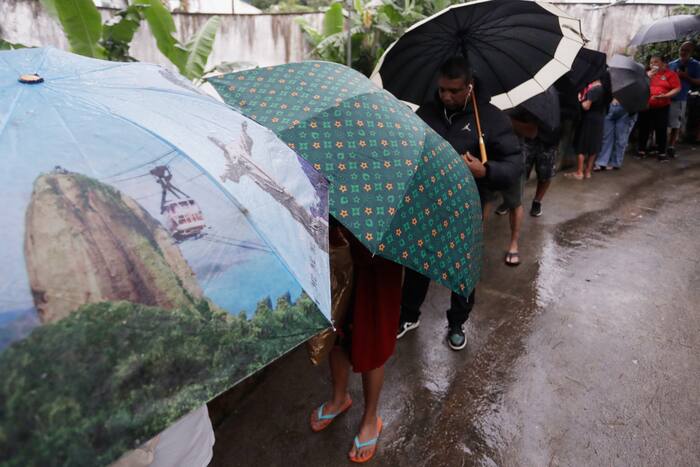
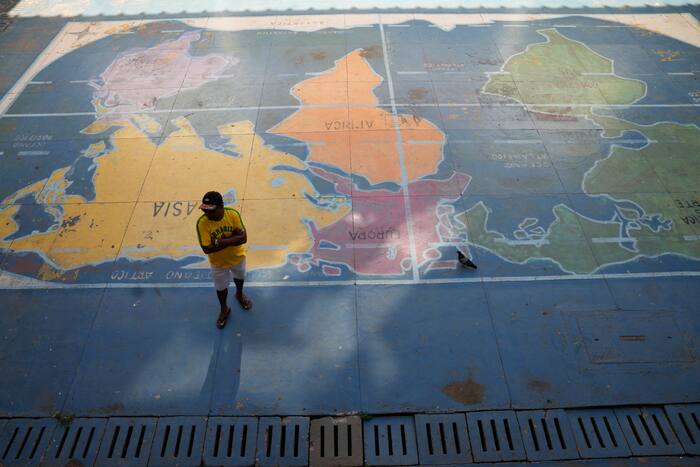
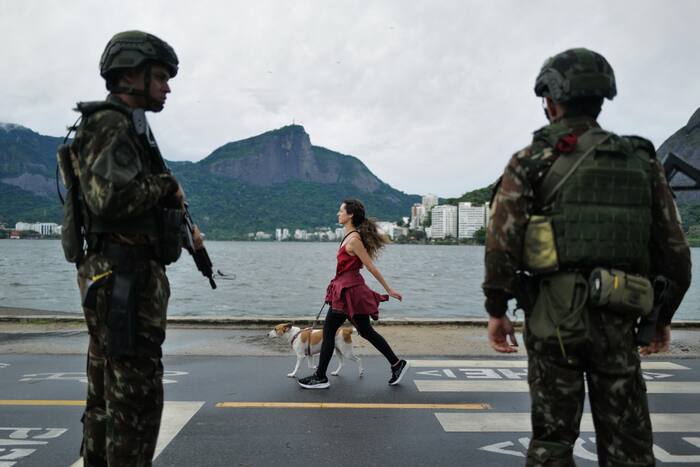
Brazilians are voting Sunday in a presidential runoff that pits leftist incumbent Luiz Inácio Lula da Silva against Sen. Flávio Bolsonaro, a far-right ally of U.S. President Donald Trump.
Bolsonaro, the son of imprisoned former President Jair Bolsonaro, bested Lula by more than 2.2 million votes in the first round of the election earlier this month. More than 33 million of the nearly 160 million registered voters did not turn out.
The difference between the two candidates is stark. Bolsonaro and Lula have opposing ideological views on issues ranging from U.S.-Brazil relations and climate change to social welfare. A win for Bolsonaro would signify a pivot to the right by Latin America’s most populous country and its largest economy in a year when Trump allies have notched victories in Chile, Peru and Colombia.
Here’s the latest:
Brazilian judge orders official’s arrest after public buses prevented from leaving
An electoral judge in the state of Bahia has ordered the arrest of the mobility secretary of the state capital Salvador. At least 75 public buses were prevented from leaving municipal garages during the presidential runoff vote.
Mayor Bruno Reis, an ally of opposition candidate Flávio Bolsonaro, blamed trade unionists for illegally sticking Workers’ Party materials onto transit vehicles for the measure.
Bahia state is a stronghold for President Luiz Inácio Lula da Silva, whose voters tend to live in areas that depend more heavily on buses.
Trump says he’s watching the Brazilian election
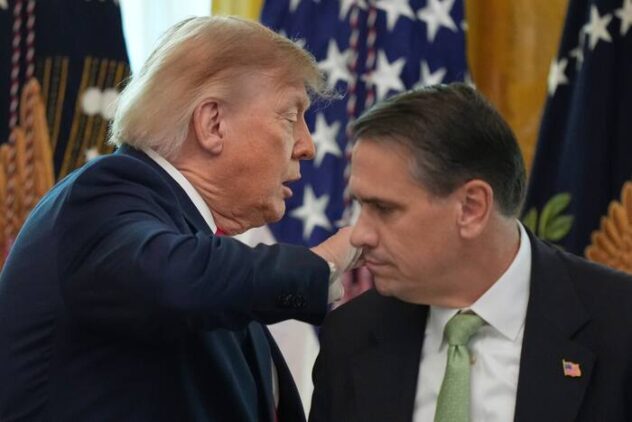
While leaving the White House on Sunday, President Donald Trump declined to endorse anyone in Brazil’s presidential election. “I don’t want to get into that,” he told reporters.
But the president added that his administration was tracking the race. “We are watching,” Trump said.
Voters who chose third-party candidates in first round could decide Brazil election
Voters who chose a third-party candidate or abstained in the first round could decide the outcome this time around.
Kelvin Gomes Pimental, a 28-year-old data analyst in Brasilia, voted for a third-party candidate in the first round, making his vote a decisive one in this election. He ultimately decided to vote for Lula.
Although he said Lula was not a perfect candidate, he ultimately disagreed more with Bolsonaro’s approach.
“It’s not even about Flávio himself. It’s also very much about the management of the other Bolsonaro government. He wanted to stage a coup,” he said. “These issues scare me a little.”
Alisson Freitas, 67, who works at a bakery in São Paulo, said he didn’t vote in the first round because he was working that day too far from his polling station. But he requested the early shift this time to support Lula.
“I don’t think his government did well this time, things are expensive, but under Jair Bolsonaro it was much worse,” Freitas said.
What newspapers in Brazil are saying
Brazilian newspapers are stressing that Sunday’s runoff between Lula and Bolsonaro will be a nail-biter, though Bolsonaro’s campaign is more optimistic after recent polls.
Folha de S.Paulo cited an analysis by its own pollster to say the election result is still open, but Lula will have to see his voters increase turnout to close the 2.2 million-vote gap between the two in the first round.
Rio de Janeiro-based O Globo, owned by Brazil’s biggest media company, reported that Bolsonaro, who was handpicked by his father, former President Jair Bolsonaro, overcame initial fears in the right-wing camp that he would not be a competitive candidate because of recent corruption investigations involving him.
Churchgoers in Rio’s Copacabana neighborhood are divided over candidates
Young and old trickled in and out of a Catholic church in Rio de Janeiro’s famed Copacabana neighborhood, where army trucks dotted the beachfront. Some people wore stickers displaying the number 13, corresponding to the digits Lula voters punch into the electronic voting machines, while others the number 22, representing Flávio Bolsonaro at the polls.
Religion became a central theme in the lead-up to the election, after a comment about Jesus by Bolsonaro went viral and triggered fears among many Catholics that he might intend to remove Our Lady of Aparecida as Brazil’s patron saint.
Maria Helena Vilanova, a 76-year-old Bolsonaro voter, said her candidate of choice would never do such a thing. She accused Lula of “giving crumbs” to the poor and said that his famed Bolsa Familia welfare program discourages people from seeking work.
“I shouldn’t have to put up with beggars asking me for money,” she said. “Brazil isn’t growing enough as a country because we’re exploited.”
Jorge Lemos, 72, said he was on his way to vote for Lula. He recalled the quotas introduced during the incumbent’s first two terms, from 2003 to 2010, which enabled his children to study and become a doctor and a dentist.
“I feel like I could never repay the debt I owe Lula,” Lemos, who is originally from Belem in the Amazon region, said. “I went into the church to ask Our Lady of Aparecida to give us strength so that the Brazilian people vote for Lula.”
How the regions split votes
Brazil was sharply divided across its five main regions in the first round of the presidential election.
Flávio Bolsonaro won in three of the country’s five regions, but Luiz Inácio Lula da Silva took the second most populous by wide margins. Bolsonaro won in the populous and rich Southeast, where Sao Paulo, Rio de Janeiro and Minas Gerais states lie. They will be the key battlegrounds in Sunday’s runoff.
Bolsonaro, 45, carried the agribusiness hub of the country’s Center-West and easily won in the South, which borders Uruguay and Argentina. Lula erased much of Bolsonaro’s gains by winning in the Northeast and also triumphed in the North, the region that includes the Amazon rainforest.
Lula voters cite his history of supporting marginalized Brazilians
Luzia da Souza, who runs a bar in a middle-class neighborhood of Rio de Janeiro, is a longtime supporter of incumbent Lula and identified herself as “a Black woman from the periphery.”
“Black people’s lives greatly improved during Lula’s terms,” she said, and blamed Congress — which is largely right-wing — for the slow pace of reform.
“A president doesn’t govern on his own,” da Souza said. “But Lula is a man of the people and he knows what it’s like to be poor. I find it impossible not to vote for him.”
Anderson Falcão, a 43-year-old journalist in Brasilia who sported a red shirt in support of Lula, said he worried about Bolsonaro’s long-term political vision, which he called “exclusionary.”
“It’s a project that harms the less fortunate, harms the worker, women, the forest, the Amazon,” he said.
Social media play outsized role
Brazil’s left was caught off guard when Flávio Bolsonaro bested incumbent Luiz Inácio Lula da Silva by over 2 million votes in Brazil’s first-round election.
Since then, it has made a clear bet on an unprecedented wave of digital activism and street protests to support Lula. The shift signals a turning point for the left, which has historically struggled to counter the far-right’s dominant online presence and savvy digital strategy.
Between the campaign’s launch on Aug. 16 and up to the first round, Lula and Bolsonaro had more or less the same number of interactions, according to data analytics company Bites. But since the beginning of the second round, the incumbent’s profiles received around 111 million interactions against Bolsonaro’s 31 million, it said.
Third-party influence
After the first-round results confirmed a runoff between Flávio Bolsonaro and Luiz Inácio Lula da Silva, eliminated candidates started trying to influence the final vote.
Third-place finisher Augusto Cury, a writer who describes himself as a moderate and garnered 3.4 million votes, endorsed Bolsonaro to align anti-establishment voters. Conservative former governors Ronaldo Caiado and Romeu Zema, who combined received almost 3 million votes, also endorsed Flávio Bolsonaro. Renan Santos, who drew 2.4 million votes on a reject-all-other-candidates platform, has endorsed neither Lula nor Bolsonaro.
Lula casts his ballot, thanks supporters
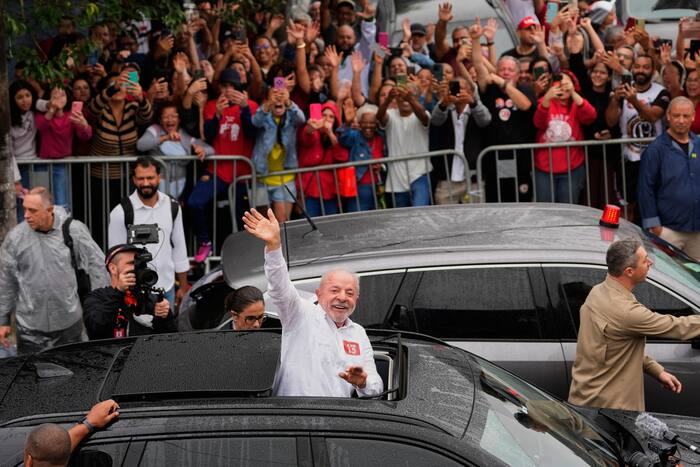
Lula voted in the city of Sao Bernardo do Campo, where he began his political career as a union leader in the 1960s.
“I am thankful to the Brazilian people. What people did to me in recent days is something I cannot repay,” he said before casting his vote and holding Brazil’s flag in front of the cameras.
He said he was still emotional about Saturday’s demonstration of support from voters in São Paulo. “I don’t think Paulista Avenue had so many people in any political event.”
“It is a lot of generosity, a lot of care, a lot of love. I will be forever grateful,” Lula said.
First lady Rosângela da Silva, Vice President Geraldo Alckmin and other allies accompanied Lula to the polling station.
Mandated voting doesn’t mean everyone votes
Voting is mandatory for literate Brazilians aged 18 to 70. But that has never been a real consideration for nonvoters, who must either submit a formal justification online or at a polling station, or pay a small fine of less than $1.
More than 33 million people did not vote in the first round of the elections on Oct. 4. Some of those were hospitalized, living overseas or working outside their voting areas. And others just chose not to.
Unexcused absences in three consecutive elections freeze tax IDs, block nonvoters from applying to state jobs, hinders loans from state banks, and delays the issuance of passports. For those who don’t want to choose a candidate even when they show up, they can cast blank or null votes.
Some Bolsonaro voters evoke desire for change
Fabianne Borges Santoro, a 45-year-old physiotherapist who lives in the neighborhood where Bolsonaro voted, said she voted for change.
“The Workers’ Party has been in power for a long time and the voice of the people is saying that we need change to see improvements in security and the cost of living,” she said, wearing a top featuring Brazil’s national colors, yellow and green. “Things are really expensive and taxes are too high.”
Santoro said she once voted for Lula’s party but now associates it with corruption, particularly after the so-called Operation Car Wash that started in 2014, when the Workers’ Party was in power and entangled dozens of politicians.
Roulen Azeredo, a 76-year-old army reservist, said he had always voted right. He also echoed the desire for a shift in the country’s direction.
“The current government did nothing,” said Azeredo, who hopes Jair Bolsonaro, who is currently serving a 27-year sentence for attempting a coup, will be freed if the former president’s eldest son wins. “His imprisonment is a disgrace.”
Battle of left versus right
Sunday’s runoff is a battle of politics as much as personalities. Brazil’s next president — Lula or Bolsonaro, a Trump ally — will determine whether U.S. influence further expands in Latin America, where Trump-allied candidates have won elections in countries that include Colombia, Argentina and Peru.
Brazil is the region’s most populous country and its largest economy. A Lula win would leave Brazil and Mexico, the region’s second most populous country, with left-of-center leaders; a Bolsonaro win would likely bring Brazil closer to Washington.
Bolsonaro casts his ballot, calls for change
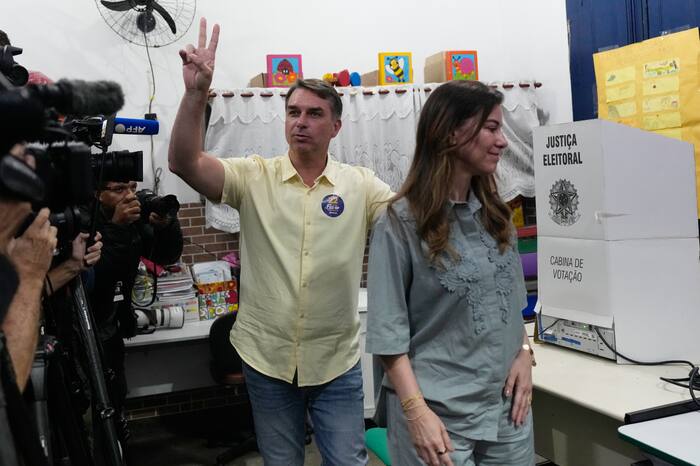
Presidential candidate Flávio Bolsonaro voted at a local school in Rio de Janeiro just after 8 a.m., accompanied by his wife, Fernanda Bolsonaro. Wearing a light yellow shirt, he smiled and waved to supporters waiting to see him in the rain.
“The time of real change has arrived,” Bolsonaro told journalists. “Brazil can’t go on another four years on its current trajectory.”
As Bolsonaro voted, supporters of the opposition candidate shouted “Lula, thief, your place is in prison,” while fans of the incumbent responded with clapping and the chant “Olé olé olé ola, Lula!” The two anthems are common in demonstrations.
Electronic voting means speedy results
In Brazil, voting is fully electronic — meaning votes are counted much more quickly than in some other countries.
Polls opened at 8 a.m. and will close at 5 p.m. Brasilia time (2000 GMT) in most of the country.
On the ballot: the presidential face-off between Lula and Bolsonaro and six gubernatorial races. Votes are tallied quickly because each ballot box calculates results locally and prints a paper summary. The encrypted data is transmitted via secure networks to the nation’s top electoral court in capital Brasilia, which aggregates and publishes the counts within hours.
The system has been in place since the 1990s with few questioning its efficiency. One of its critics is former President Bolsonaro.