Tobias Harris raises the floor of a Spurs team that already had a high ceiling
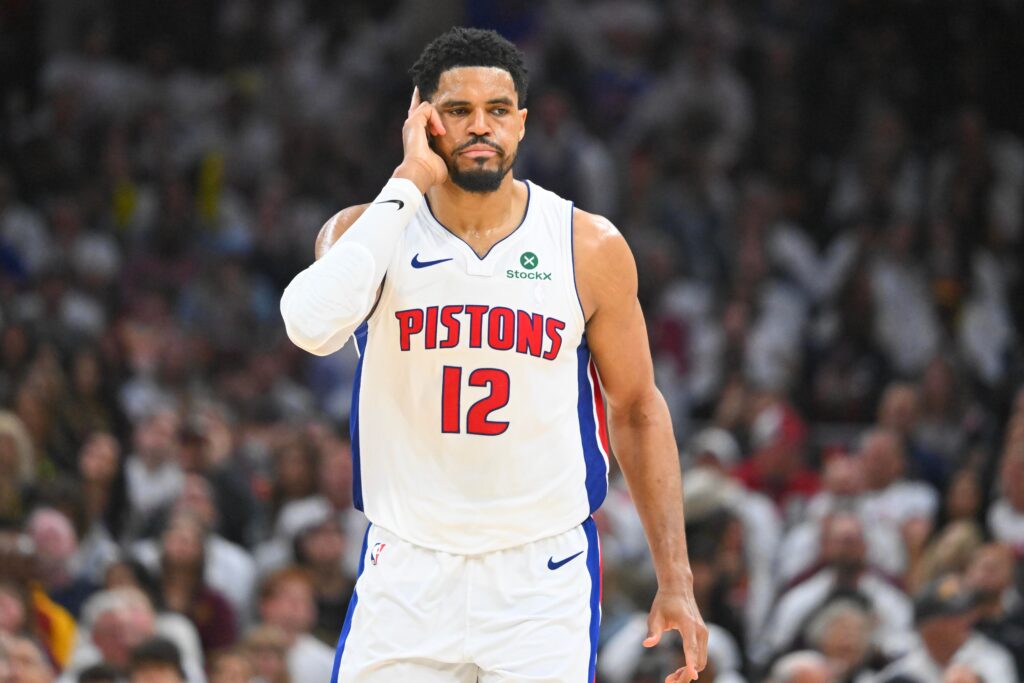
The Spurs, which didn’t seem to be preparing to make any major moves in the offseason, made a solid if not necessarily exciting addition. San Antonio agreed to a two-year, $31 million deal with free agent forward Tobias Harris using their full non-taxpayer’s mid-level exception.
The signing raises some questions about the starting lineup and how the rotation will shake up, but it also brings something the 2025/26 Spurs lacked: a floor-raiser that should bring stability to some units without taking anything away from a team that already had a sky-high ceiling.
Harris, 33, is a known commodity. The veteran was never a star, even when he was compensated as one, but he has clear strengths and not many significant weaknesses. His career averages of 16 points and six rebounds on solid shooting splits paint an accurate picture of the type of production he offers. At this stage of his career, his scoring is not what it used to be in his prime, but he’s someone who can hit an open three, score against mismatches from midrange and at the bucket, and keep the ball moving. Defensively, he’s not a stopper but uses his size and remaining athleticism well against forwards and has enough mobility to not be a sieve in the perimeter. He’s also a good rebounder and a durable player, appearing in under 60 games just twice, in his first two seasons, while playing 70 or more in nine of his 15 years in the league. In other words, a solid all-around contributor.
If that doesn’t sound too exhilarating, it’s understandable. The offseason has featured big, shocking trades involving stars and, in general, offers the possibility to dream about underrated signings that change the fortune of teams lucky or smart enough to find hidden gems. In that context, adding a soon-to-be 34-year-old forward who disappointed when a franchise bet highly on him and can be accurately described as steady if you are a fan of his game and uninteresting if you aren’t, can be considered disappointing. The mystery box is always more alluraing that an adequate prize, and the offseason is a time of endless opportunities until a team actually makes its moves and reality sets in. It’s fine to look at Harris as the big addition the Spurs made and be simply content instead of thrilled. He’s just not that exciting.
The thing is, these Spurs didn’t really need more excitement. Victor Wembanyama and the guards provide plenty of that. What a team that, at its best, can beat anyone while being exhilarating to watch needed was to not go through so many surprisingly low moments in which they look too young, too nonchalant, too predictable, or too confused to stop opponent runs or avoid falling into holes. San Antonio had arguably the highest ceiling out of any group in the NBA last season, as their trip to the Finals and the sizable leads they held in each game proved. The star power was definitely there. The problem was their low floor; they lacked steadiness during stretches, and that often got them in trouble. And in that area, a player like Harris can absolutely help, as he has done for most of the teams he’s played for in his career.
One of San Antonio’s issues was defensive rebounding. Harris is well above average in that area, performing well individually both in the regular season and the playoffs. Untimely turnovers were also an issue at times for the Silver and Black, and Harris is not a mistake-prone player. Occasionally, the offense would stall out, with limited players ending up with the ball in their hands late in the clock. Harris is not by any measure an offensive engine, as evidenced by the Pistons’ struggles to create good looks when Cade Cunningham didn’t have the ball, but he can bail out the odd possession as a pick-and-roll ball handler or post scorer. He has the size and strength defensively to survive against most forwards, and he knows when to direct his man towards a help defender, both qualities that some of the Spurs’ power forwards lacked at times. He’s a more reliable version of what the Silver and Black had, essentially.
The only area in which his addition brings uncertainty is in the rotation. How big will his role be, and what will happen to the other players who share his position? There is a serious logjam now in the frontcourt that could prove challenging to solve. The 96 guard minutes should be split mostly between De’Aaron Fox, Stephon Castle, and Dylan Harper, with Devin Vassell getting the remaining scraps. But what happens with the small forward and power forward minutes? Do Vassell and Julian Champagnie continue to start, or does one of them sit to make room for Harris, who has started for practically his entire career? And how does the playing time get split? There are 96 minutes to spread around between Vassell, Champagnie, Keldon Johnson, Carter Bryant, and Harris. Someone is going to have a smaller role than they are used to, and it will be up to Mitch Johnson to figure out how to keep everyone happy.
What a great problem to have. With a couple of roster spots left to fill, the Spurs appear to have too many viable regular-season rotation players already and have added a proven playoff performer who averaged 18 and 7 for a second-round team last postseason. Whether he starts, which seems likely, or comes off the bench, Harris will be there when Mitch Johnson needs someone who will, more often than not, provide the production expected of him.
Normally, additions are judged by how much better a team is at its peak with them on the court. With Harris, that framework doesn’t really work because the best version of the Spurs didn’t have much room to grow beyond the internal development of their young superstars. What San Antonio needed was someone who was steady enough to help them avoid their worst version, and Harris seems like the perfect man for the job.