Job security is sparse for NBA coaches, will Mitch Johnson be an exception?
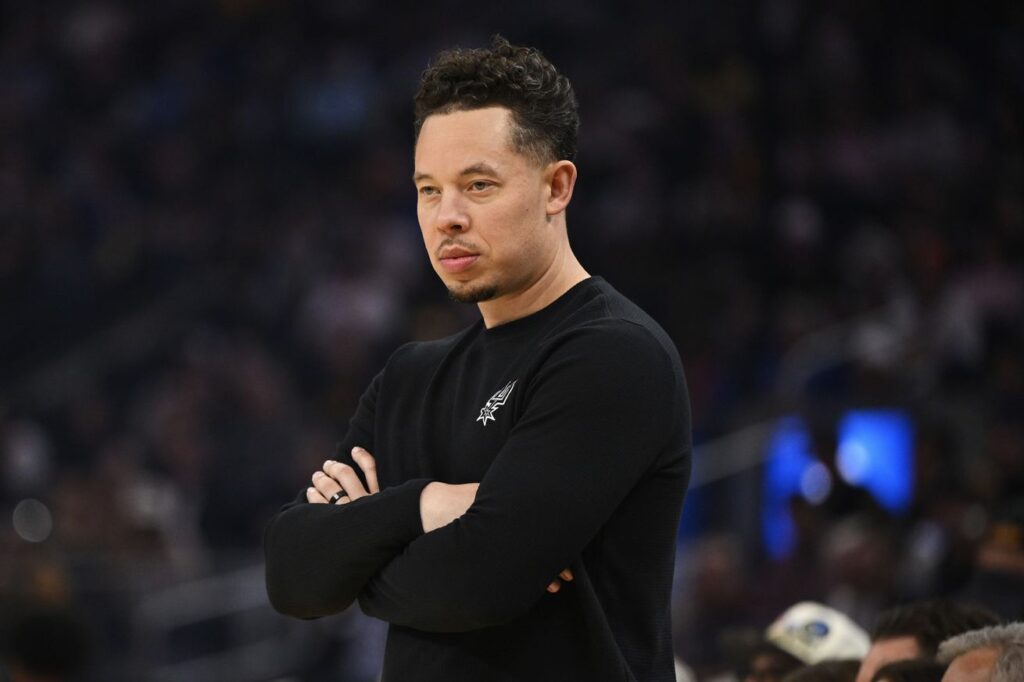
NBA coaches only last two to three years on average, but with a strong organization behind him, Mitch Johnson might be able to replicate the longevity of those before him.
In terms of job security, the NBA head coach is typically not a safe position to hold. Depending on what data you look at, coaches on average only hold on to their jobs for two to three seasons. However, over the past 29 years, the Spurs with Gregg Popovich have been an outlier with no turnover whatsoever.
Now, as newly appointed Mitch Johnson officially takes the reins, fans find themselves in foreign territory. Albeit quite familiar to the rest of the league, San Antonio is two generations removed from having to countenance the uncertainty of a new coach.
Given the previous, it’s fair to question how much of a runway Johnson will be given. Having served the better part of a season as the Interim Head Coach, it was a great opportunity to get his feet wet with minimal pressure. But now, the practice run is over.
Part of the reason for high coach turnover is ownership and team executives’ low tolerance for failure. Which isn’t a totally unfair quality to have when an organization’s overall goal is to win basketball games. However, progress in the NBA isn’t always linear, with players or coaches. As many fans know, sometimes things need to be torn down in order to build them back up. And while that is understood by all, it doesn’t mean coaches’ jobs are safe at any point in the process and can often be the first to go if ownership feels it’s time for a change or if a general manager needs to save face and their own job. It’s not a matter of if a coach is on the hot seat, but how hot it currently is.
So, will Johnson be subject to that same treatment, and will San Antonio then be another contributor to the NBA coaching carousel?
Hopefully not. What gives a coach longevity with an organization can be boiled down to two things and one of which can usually lead to the other: a strong foundational team infrastructure and championships.
It’s important to note that it is distinctly “championships” (plural) and not one championship. In fact, it seems the time from one ring to the next can actually be the most dangerous time in a coach’s career. Going back to 2020, three of the five championship coaches (Frank Vogel, Mike Budenholzer, Michael Malone) have been fired, with Vogel and Budenholzer being served termination papers twice, both by the Phoenix Suns. This inversely professes the second reason a coach will find longevity. Internally, although these coaches won championships, their organizations were not foundational strong. Their coaches didn’t have much margin for error, which shows a lack of trust from their employers. Not to say that all of the firings were undeserved or that all were deserved, but it shows the fickle environment these coaches find themselves in when winning it all isn’t enough to secure at least a little benefit of the doubt.
It’s often said that it’s not if a coach gets fired, but when. It’s a tough, mostly thankless job, and can be even tougher when responsible for a flowering superstar(s). But, in the rare circumstances of the right coach and the right amount of trust, it can work out quite well.
Gregg Popovich was a rare scenario. He was hired on as the GM and given the coaching job by himself. From there, all he did was win. Like Johnson, it was non-standard circumstances that landed him the job, and like Johnson, he had a generational superstar ready to take over the league.
Another situation to look at is in Miami. Despite a few heated moments and Lebron James all but calling for him to be fired, the Heat stood by their choice of Erik Spoelstra as the coach. It worked out quite well for all involved, and Spoelstra is respected as one of the best and longest tenured coaches in the league.
The parallel that can be drawn to Johnson here is what Spoelstra had going for him, Pat Reilly. Reilly, as an executive, was a former coach with several rings and had full faith and trust in his chosen successor. Spoelstra built a rapport with the team and Reilly, working his way up from the video room to head coach over the course of 13 years. Now, as Popovich steps into that same executive role, Johnson is his chosen successor, having been with the organization since 2016. He can serve as a guide and a shield for him when necessary.
Over the interim period, Johnson had a .416 winning percentage. Not bad for a start, given the injuries the Spurs dealt with this year to their two best players.
Time will tell if Johnson can have more parallels with the Heat and Spoelstra. Right now, he has the backing of a strong organization and appears to have the room to grow and learn alongside his young stars. The hope is that he will be another long-term investment and the Spurs can continue to skirt the NBA’s unforgiving trend of hiring and firing coaches. The rest is up to him.