2024 NBA Finals Preview: Boston Celtics vs. Dallas Mavericks
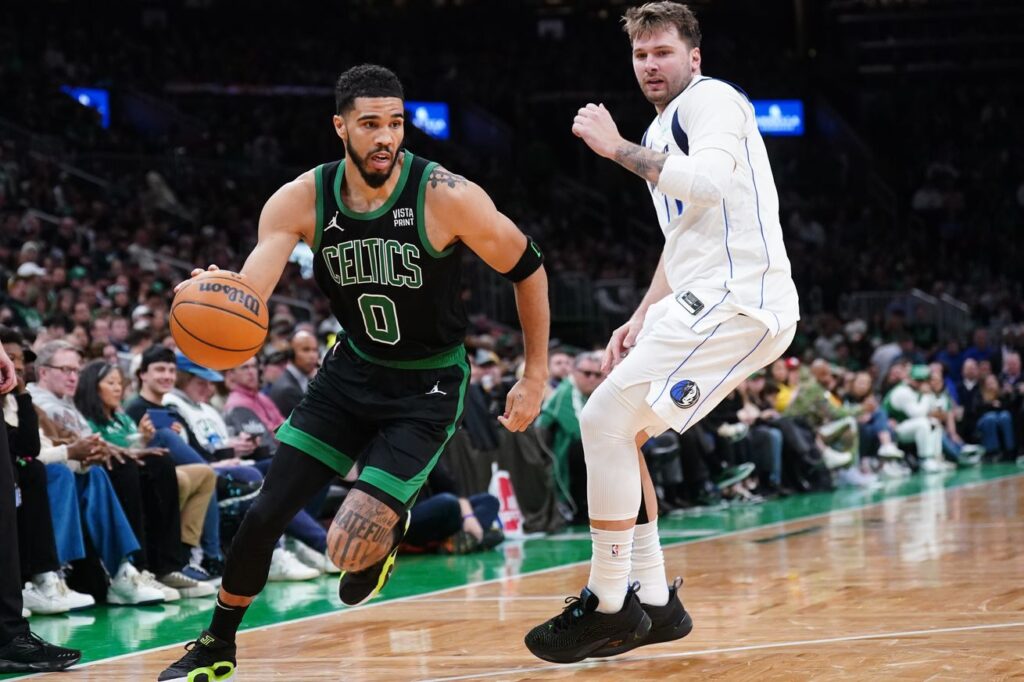
Is Boston destined to raise that elusive 18th banner, or will the legend of Luka continue to grow?
Following three grueling rounds of playoff basketball, the Mavericks and Luka Doncic are set to make their much anticipated debut on the sport’s biggest stage. On the other side awaits the Celtics, who, I believe, have also participated in the postseason.
Regardless of their path to the finals, this should be a matchup for the ages: Boston has a starting five filled with All-Star quality players, while Dallas is spearheaded by a two-headed monster with role players that perfectly complements their lethal duo.
So, will the Celtics’ superior depth win out, or is Luka destined to be crowned a champion and become the Lisan al-Gaib? And now that the basketball world has experienced a re-awakening to Kyrie, will he exorcise his Boston demons, or be stomped on by Lucky the Leprechaun?
Let’s find out.
Note: all stats are from the playoffs, unless otherwise stated.
Key storylines
Three-point attempts
Boston was the most prolific three-point shooting team during the regular season, and that’s continued in the playoffs: 43.8% of their shots have come from deep, which is the highest rate among all clubs. Dallas, meanwhile, has conceded a mediocre 35.7% of opponents’ shots from beyond the arc.
It shouldn’t be surprising, then, that the Mavericks’ defensive identity comes more from their elite rim protection. Opponents are shooting a measly 59.4% around the basket, a rate that would’ve been the best percentage in the regular season. However, they haven’t played a five-out team like the Celtics yet, and the return of Kristaps Porzingis will force Dallas’ bigs to guard more on the perimeter than roam the paint.
On the other end, Boston is willing to concede lots of above-the-break 3s, but they’re great at limiting corner attempts (a nice 6.9% of opponents’ shots come from there, which is the lowest percentage among postseason teams). Dallas, though, shoots a ton from the corner (13%, 1st), and a bunch come from role players such as PJ Washington and Derrick Jones Jr. Is Boston willing to sag off of them to protect the rim? We’ll find out soon.
The transition battle
Celtics skeptics often point to their halfcourt offense as their achilles heel, as they have a propensity to rely on low-percentage shots under pressure. With that said, Boston’s 106.8 offensive half-court rating ranks first, but it’s also come against three mediocre to below-average defenses in the East.
Given that Dallas’ half-court defense is also elite (92.8 defensive rating, 3rd), the Celtics will need to prioritize getting out in transition more, something that they’ve been reluctant to do — only 10.3% of their possession have come in transition, ranking 18th out of the 20 playoff and play-in teams.
That number is even more surprising considering that Boston is 2nd in defensive rebounding rate at 78.4% and 1st in defensive free throw rate at just 11.5% (Dallas also has a FT rate of 21%, so that’s another matchup to monitor). Simply put, they’ve got plenty of chances to push the pace after regaining possession from a miss, and opponents don’t have many opportunities to set their defense, either, given the lack of trips they make to the line. If the Celtics want to keep up with the Mavs, they’ll need to run more against a Dallas team that is below-average in transition opportunities conceded (14.1% of defensive possessions, 13th).
Offensive rebounding and second-chance points
Along with being an elite defensive-rebounding team, Boston is also first in second-chance points allowed at just 8.3, but they’ll be challenged against the Mavs’ big frontline.
Among every team that made it past the first round, Dallas is second in both offensive rebounding rate (29.8%) and second-chance points per game (13.4). The Mavs will have an even harder grabbing their own misses with Porzingis back for Boston, but they’ll need to maximize their amount of offensive possessions against an elite Celtics defense.
Big questions
How will Boston defend Luka
Luka is the best scheme-destroyer in the league — a one-man offense who exploits every defensive matchup thrown his way. Even so, there are ways to make his job more difficult. Jaylen Brown will likely draw the initial assignment on the Slovenian wunderkind, but that won’t stop Luka from hunting his old buddy Porzingis in the pick-and-roll.
Boston could counter by having Tingus Pingus sag off of Derrick Jones Jr. instead of guarding one of Dallas’ bigs — although DJJ is shooting 38.% from deep, he’s only averaging 3.2 attempts per game. As mentioned before, though, the Mavs have been lights out on corner threes, and DJJ is no different: he’s converting 46% of those shots but on just 2.2 attempts per game.
If Porzingis isn’t glued to DJJ, he can focus more on protecting the rim, where he’s been elite defensively: in the regular season, opponents shot just 60.3% around the basket with Porzingis playing (95th percentile), but that’s ballooned to 70.6% in the playoffs with Al Horford as their main rim protector. If Dallas still decides to hunt Porzingis, Luka will have a harder time throwing lobs since DJJ is a worse screen and finisher than Lively and Gafford, and the lane will be clogged, too.
Yet, with Luka being a basketball savant, he’ll still find mismatches, so let’s analyze the different schemes that Boston can employ to make things tougher for him.
Blitz: According to Zach Lowe, the Mavs scored just 0.72 points per possession in the first four games against the Timberwolves when Rudy Gobert was involved in a blitz on Luka. That’s a very good number for Minnesota, but Boston can’t rely on it because the result could be a 4 on 3 that leads to an open three:
— Bill Huan (@bill_huan) May 30, 2024
The most important factor for a blitz is the personnel that the Mavs have on the court. Even though Gafford was the center in this example, he’s much slower than Lively is at making reads and finding open shooters. If he’s on the court along with some non-shooters, this could be the Celtics’ best strategy.
Drop: Lowe also shared that the Mav scored 1.26 points per possession with Gobert dropping against Luka, an example of which can be seen below.
— Bill Huan (@bill_huan) May 30, 2024
This play, in particular, is one that the Celtics need to be wary of. It’s one of Dallas’ pet actions that involves a double drag, putting multiple players into the action and confusing the defense. It’s very hard for the opposition to discern who they should cover, and if the big drops, Luka can either shoot a floater or throw a lob at the last second.
1.26 points is a huge number, but that doesn’t mean that there are no situations in which Boston should drop. Again, it all depends on personnel, which brings us to our final coverage.
Switch: One defensive advantage that Boston has over every other team is their size and switchability. Jrue Holiday and Jayson Tatum are both strong enough to guard Gafford/Lively and PJ Washington if Porzingis is on DJJ, while “Maximum” Derrick White hounds Kyrie. Both Holiday and Tatum can switch on to Luka without conceding a mismatch if the latter runs a pick-and-roll with a big, defeating much of the purpose of such a play. Moreover, the Celtics are one of the best teams at pre-switching, which they’ll do a ton of to prevent Porzingis from guarding Luka.
However, Dallas can still use multiple screeners (as shown above) to trigger that very scenario, and in that case, Boston could send a blitz to get the ball out of Luka’s hands. If the Joker (sorry, Joe Mazzula) is feeling frisky, the Celtics might even be content with him playing one-on-one against Porzingis if the shot clock is winding down. They’ll just need to hope that he doesn’t start mouthing English words in Slovenian after.
As you can see, there isn’t one way of slowing down Luka. Boston’s best bet would be to throw a variety of schemes at him depending on the matchups, personnel on the court, and time left on the shot clock. Praying to the basketball gods probably wouldn’t hurt, either.
How will Dallas adjust to Porzingis’ gravity?
The Mavs have been able to sag off of at least one player in every series they’ve played in so far: Zubac for the Clippers, Giddey for the Thunder, and Gobert for the Wolves. Boston, however, is an entirely different beast with the return of Porzingis, who shot 37.5% from deep in the regular season on 5.1 attempts per game.
With that in mind, an important stat to monitor will be the Celtics’ three-point attempts vs their number of drives. Assuming Dallas is forced to guard Porzingis on the perimeter, the Celtics will also need to adjust their offensive identity to prioritize more rim attacks — only 28.9% of their shots have come around the basket, ranking 14th out of the 16 participating playoff teams.
On the other hand, Boston has been elite at finishing at the rim, as they’ve converted a ludicrous 74.5% (1st) of their attempts within four feet of the basket. They won’t continue shooting that well against an elite rim protection team in the Mavs, and the Celtics need to drive more if their treys aren’t dropping, especially given the open lanes that Porzingis’ gravity will create.
Furthermore, getting Porzingis back allows Boston to run some of their most dangerous pet actions, such as horns. Opposing defenders need to stick to him at the elbow and top of the key due to his shooting prowess, which unlocks plays for both him and his teammates.
Take a look at the play below. Tatum, Pritchard, and Porzingis’ gravity forces Brooklyn to guard the perimeter, leaving the paint unoccupied. The Nets defense then breaks down after multiple screens set by Tatum, leading to an open dunk for Porzingis.
— Bill Huan (@bill_huan) June 2, 2024
Another play that Boston’s horns action can lead to is a Porzingis post-up. In the regular season, the Celtics’ big man averaged the 9th most post-ups per game while scoring a scorching 1.30 points on such possessions, which ranked in the 96th percentile and was 0.16 points higher than both Joel Embiid and Nikola Jokic.
Although Porzingis doesn’t score in the example below, it still shows just how easily Boston can force a mismatch for him, and if the opposing team sends help, he could’ve kicked it out to a teammate for an open three (Tatum, in this instance).
— Bill Huan (@bill_huan) June 2, 2024
The most important thing for the Celtics is that they actually run actions instead of just playing iso-ball before chucking up a contested three. When everyone is involved, Boston’s offense is virtually unstoppable, and they’ll need to remember that against a Mavs team that approaches every offensive possession with the cold calculus of a T-1000.
X-factor: Maxi Kleber
Kleber’s not the same player he was when the Mavs made their previous conference finals appearance, but his shooting and versatility could still play a big role in the finals. If Boston indeed has Porzingis sag off of DJJ and the latter isn’t hitting his shots, Dallas could sub in Kleber to pull every Celtic defender out of the paint. Kleber has made a whopping 50% of his triples this postseason, and although that only came in eight games, he also converted 34.8% of his attempts in the regular season and is a known three-point threat.
Defensively, Kleber is reliable too. He’s not DJJ — who’s quick and longer than you expect — but his strength and IQ make up for it, and the Mavs won’t be conceding a huge mismatch if he switches on to any Celtic. If a less mobile big like Gafford is being hunted relentlessly by Boston, Kleber could sub in to make Dallas more switchable, and he’s capable of providing some rim protection as well.
In the end, the stars will be the ones who dictate the finals, but role players such as Kleber can also swing a series. Just ask the Thunder how they feel about PJ Washington: OKC will probably chalk that up to bad timing, but hey, they’re still responsible for not being adaptable and tweaking their scheme.
Final thoughts and prediction
Although we spent the most time discussing how the Celtics could defend Luka, this series will ultimately be determined by how Boston executes offensively. We already know that the Mavs will take advantage of every opportunity with Luka at the helm, but the Celtics still have lots of rage-inducing plays that are self-generated. Take the example below, where they forced a low-percentage shot even though they had 12 seconds left to run an action.
— Bill Huan (@bill_huan) May 30, 2024
Boston loves to hunt mismatches, and they’ll try and get Luka switched onto Tatum and Brown to wear him out. When that happens, though, Boston can’t be satisfied with just playing hero ball. The Celtics need to continue executing proper plays to get the best looks possible, and that’ll make Luka exert more energy on defense, too.
This will be especially important during crunch time considering that Dallas has two of the best closers in basketball in Luka and Kyrie. Contrary to popular belief, Boston has been elite during clutch minutes this year, which, according to NBA.com, includes the “final five minutes of the fourth quarter or overtime when the score is within five points.”
In 127 minutes of clutch time in the regular season, the Celtics had the fourth-highest net rating (15.4) and went 21-12 in the games that counted towards those minutes. They’ve been even better in the playoffs by going 4-0 with a staggering 43.9(!!!) net rating, although that’s only come in 19 minutes of play. Put simply, the narrative that Boston chokes has been overblown: outside of a disappointing series against the Heat last year, they’ve been ahead of schedule in all of their previous deep playoff runs.
Yet, it’s indisputable that they’ve had a bye to the finals, and they’ll face an even better crunch-time team in the Mavs: Dallas had a 20.5 net rating in 106 clutch minutes in the regular season and went 23-9 in those games.
Even with that in mind, the Celtics’ star depth makes it difficult to pick against them. Dallas has been an elite team post-All-Star break, but Boston has been elite all season, and the numbers point to them being an all-time great team. Luka’s transcendent talent will make this a very competitive series, but the Celtics’ versatility and mismatches they’ll present should be too great for even Luka Magic to overcome.
So, considering everything, it’s finally time for Mazzula to become “Front-Row Joe” and for Boston to shed their Charmin’ Soft label. The Celtics will bring big ol’ Larry home and raise banner 18, GUARANTEED!
Prediction: Boston in 7.
All stats courtesy of Cleaning the Glass and NBA Stats.